BTC US$74.9k. IR helps prevent $13M in Singapore crypto scams
Andrew FentonMarket update5 min read
Key takeaways
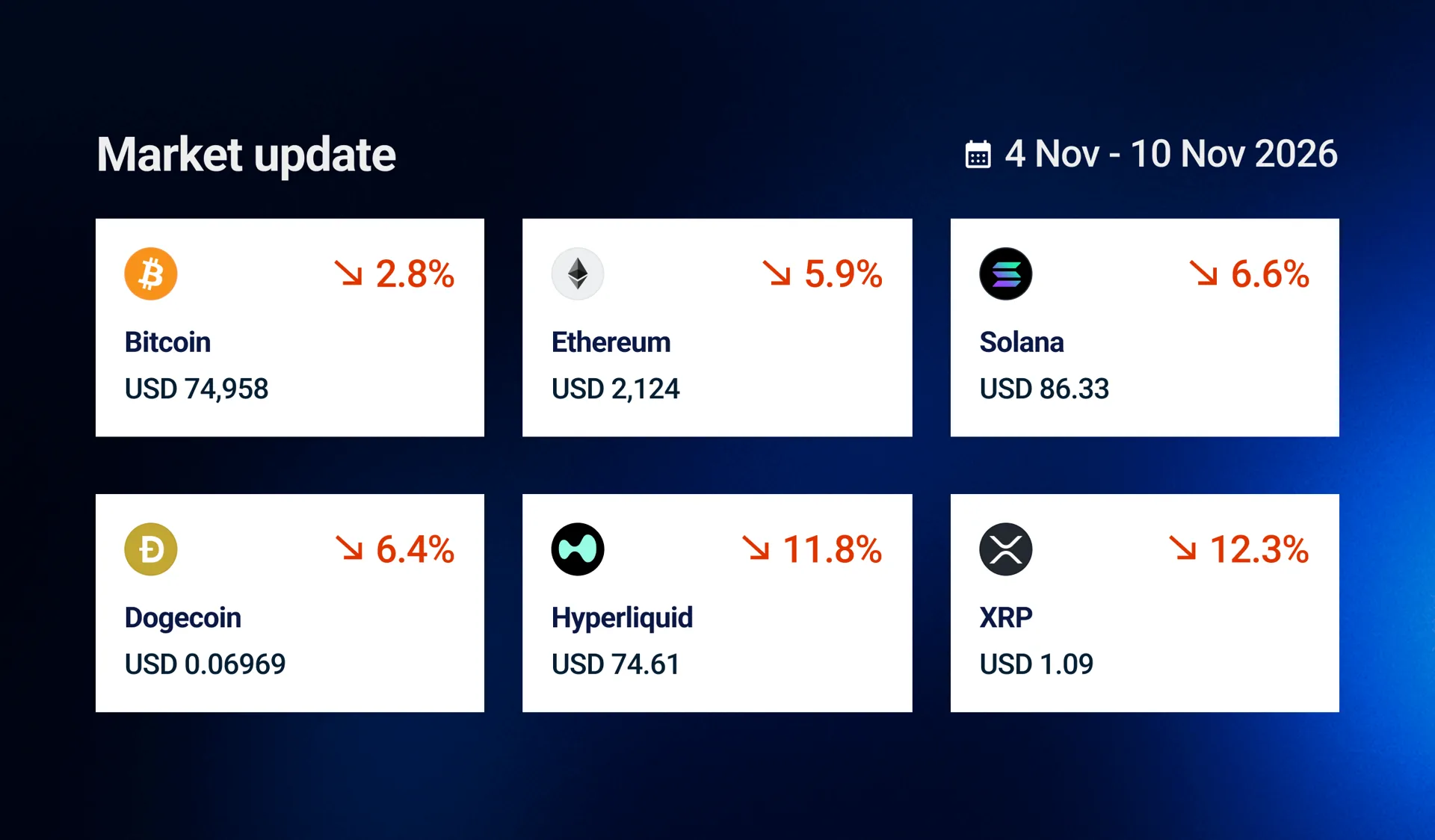
- Bitcoin closed down for a fifth week in a row, falling 2.8% to around US$74,958.
- A joint operation including Independent Reserve helped prevent 383 Singapore victims from losing US$13 million to crypto scams.
- The Crypto Fear and Greed Index hit Extreme Fear (25) on the weekend, then recovered to 29.
Market insights
Markets have been on a rollercoaster ride since the US midterm elections. After initially rising as the Democrats swept both houses, the S&P 500 crashed by 4.4% the following day amid fears of increased AI regulation and a slowdown in data centre construction. Crypto also suffered, with some notable crypto sceptics back in charge. While AI investors bought the stock market dip overnight, encouraged by Morgan Stanley, Bitcoin remains down. It closed down for a fifth consecutive week in the red, and fell below the 50-week moving average, although Galaxy's Alex Thorn says that metric is not as bad as it seems.
Bitcoin finishes the week down 2.8% from the same time seven days ago, trading around US$74,958, while Ethereum lost 5.9% and is trading around US$2,124. XRP fell 12.3%, Solana dipped 6.6%, Hyperliquid lost 11.8%, and Dogecoin eased by 6.4%. The TRUMP memecoin lost a third of its value and fell out of the top 100.
The Crypto Fear and Greed Index dipped to 25 on the weekend for its first Extreme Fear reading since 6 August. It has since recovered to 29, which is just Fear.
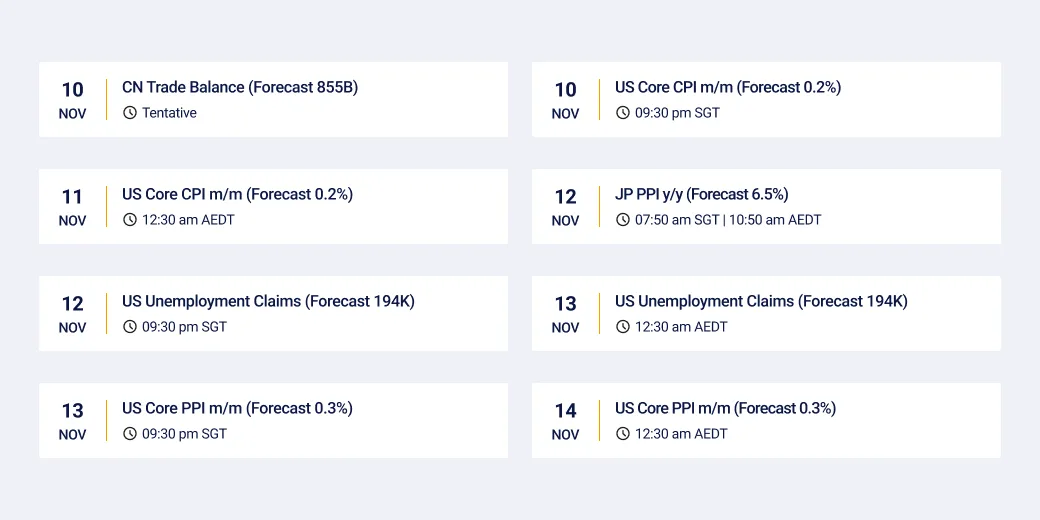
Key economic calendar events
In headlines
IR helps prevent US$13M in Singapore crypto scams
A fifth joint operation between law enforcement and local exchanges, including Independent Reserve, has successfully prevented 383 victims from losing US$13 million to crypto scams between September and the end of October. The crackdown extended beyond Singapore, with the Cyber Command team sharing blockchain intelligence with foreign law enforcement partners, including the US FBI, Australia's New South Wales Police Force and the Canadian Anti-Fraud Centre.

Was the US election bad for crypto?
While the US midterms have restored some crypto sceptics to positions of power, the overall picture isn't as bad as it could be. The Fairshake super PAC spent US$154.5 million across 93 races and said it had backed the winning candidate in all but seven races, for a 92% success rate. According to Stand with Crypto, 50 out of 100 senators are now pro-crypto, while just 33 are opponents. In the House of Representatives, 242 members of Congress support crypto, and only 106 oppose it. The House Democrats are reportedly discussing a broader crypto market structure bill, building on Maxine Waters' 2025 Crypto Investor and Consumer Bill of Rights. There is an outside chance CLARITY could get resurrected, but only with much stronger ethics provisions aimed at President Donald Trump (who has veto power).
Fairshake spent US$64 million campaigning against crypto-hating Sherrod Brown, but he was elected anyway and is expected to take a role on the Senate Agriculture Committee. Elizabeth Warren, the leader of the anti-crypto army, is expected to head the Senate Banking Committee. She has already indicated she'll launch investigations into "Trump family crypto businesses" while the incoming chair of the Investigations Committee, Senator Richard Blumenthal, has already demanded documents from Tether, Binance, WLFI and other Trump linked crypto firms.
Ethereum speeds up post-quantum plan
Ethereum researcher Justin Drake, who is leading the Lean Ethereum overhaul, wants to complete the post-quantum upgrade by December 2028, a year earlier than scheduled. He said that gives developers 24 months to deliver three additional network upgrades. Some devs suggest the PQ transition might happen even faster. Officially, however, the Ethereum Foundation is still targeting 2029. It says the 2027 Hegota fork will be the last without lean features (rebuilding Ethereum with ZK proofs); the l* fork will ship the LeanVM and Lean transactions, and J* will add lean attestations, DA sampling and PCS in 2029. However, the Glamsterdam fork is currently on hold until the devs can sort out unforeseen gas implications on 200,000 smart contracts.
Gnosis co-founder Martin Köppelmann launched Ethereum's first native rollup, called RollupX, at DevCon. For users, native rollups will function exactly like Ethereum and offer the same security guarantees. It's on devnet right now. Meanwhile, creator Vitalik Buterin wants ETH to embrace a store-of-value narrative.
Separately, the Ethereum Foundation is facing a lawsuit from a former employee who says she was fired for starting a petition against a new policy. The policy reportedly required staff to sign a pledge stating, as a joke, that they would "commit suicide" if they failed to comply.
First Innovation Exemption stock trades
The first tokenised stock trading venue to operate under the SEC's new "Innovation Exemption" began limited trading last week. TSV LLC facilitated trades in tokenised shares of Canton Strategic Holdings, the network it operates. The OKXICE joint stock token venture between OKX and NYSE parent Intercontinental Exchange is off to a poor start, with 67 companies now objecting to having their stocks tokenised on the platform. The NYSE is also launching tokenised trading on a separate platform that it has just announced will be powered by a permissioned Avalanche subnet.
Binance hack took months
Binance released a report detailing the sophisticated, months-long operation that saw North Korean hackers steal US$6.34 billion from its wallets. The first breach occurred in June, when an employee was tricked into downloading malware while trying to access an AI coding tool. The incident was quickly detected, but it allowed the hackers to obtain information about employees on the wallet infrastructure team. In September, an engineer was tricked during a fake job interview into downloading more malware, and in October, the hackers gained access to Binance's wallet-signing service. After the attack started, it took almost four hours to revoke their permissions.
As expected, cross-chain DEX THORChain has ignored the FBI's explicit warning and restarted permissionless swaps. Prior to the halt of trading (which was unrelated to the Binance hack), the platform had already processed US$46 million of stolen funds according to Chainalysis.
CFTC approves single-stock perps trading
The CFTC in America has approved trading in single-stock perpetual futures. Prediction market platform Kalshi launched single-stock perps on 5 November and saw more than US$300 million in trading volume in the first few hours. An alliance including CBOE and Citadel Securities are suing over the approval, arguing perps are functionally swaps rather than futures. CME Group has also sued. The regulators frame the litigation as protectionism by incumbents. Interestingly, perps demonstrated their value on Hyperliquid over the weekend, foreshadowing Monday's drop in NVIDIA's stock price.
Singapore news
Five major banks, including HSBC, Kinexys, MUFG, Société Générale-Forge under BNP Paribas, and Standard Chartered, joined forces to launch the Global Layer One Organisation (GL1) in Singapore. The non-profit will promote common standards for tokenised financial markets. South Korea, meanwhile, has delayed its 22% crypto gains tax for a fourth time, and it will now start in 2029.
Until next week, Happy Trading!

About the author
Andrew Fenton
Market update writer
Andrew is a senior journalist and editor with Cointelegraph. He has been writing Independent Reserve's market update since 2019.
Related Posts:
Tags:market update