Trust in crypto among Singaporeans continues to be shaped by regulation, but expectations are shifting. The 2026 edition of the Independent Reserve Cryptocurrency Index (IRCI) found that trust is now increasingly influenced by how crypto companies behave and protect users.
At the same time, trust is now less about understanding how crypto works and more about external factors such as regulation, security, and how companies operate. Social proof, such as uptake by friends or the community, has fallen to 14%, indicating social proof plays a limited role in shaping trust despite relatively strong recommendation levels.
Crypto investors are more influenced by real-world signals. 36% cite business adoption, versus 23% among non-investors, and 18% cite social uptake, versus 11%. This suggests that lived experience shapes trust. Investors also show stronger demand for control and protection. 1 in 3 value privacy and insurance, compared to 19% and 22% among non-investors.
Price stability is equally important across both groups at around 45%. This indicates volatility remains a universal barrier to trust.
What would increase trust in crypto: Investors vs Non-investors
| Crypto investors | Non-investors | |
| Clarity around government regulation | 49% | 56% |
| Crypto companies behave responsibly to ensure the safety of your crypto. | 47% | 42% |
| Stability in price | 44% | 46% |
| Ease of access and ease of use | 37% | 33% |
| Businesses using it | 36% | 23% |
| Maintaining privacy / not being monitored | 30% | 19% |
| Education about how it works | 29% | 44% |
| An option to insure your crypto | 29% | 22% |
| Uptake by friends, colleagues and community | 18% | 11% |
Barriers to crypto ownership
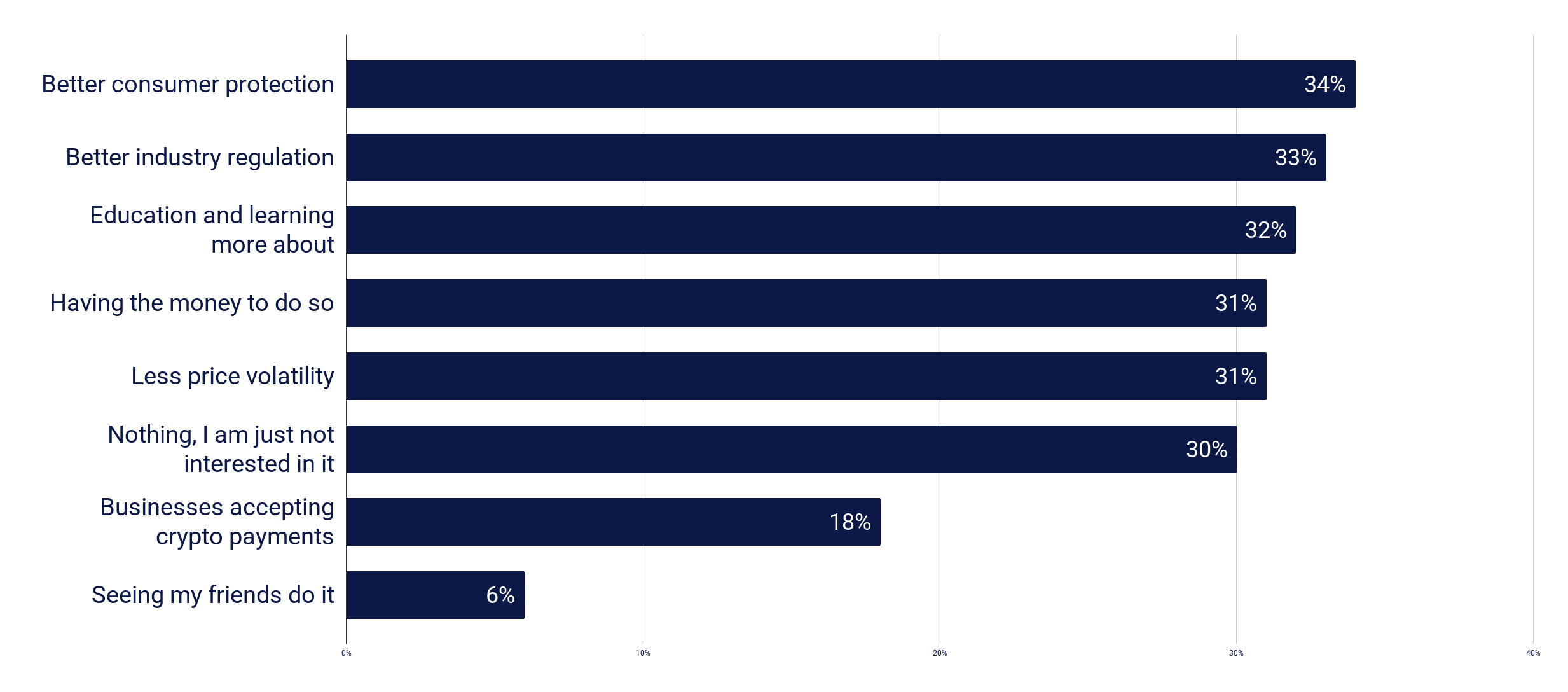
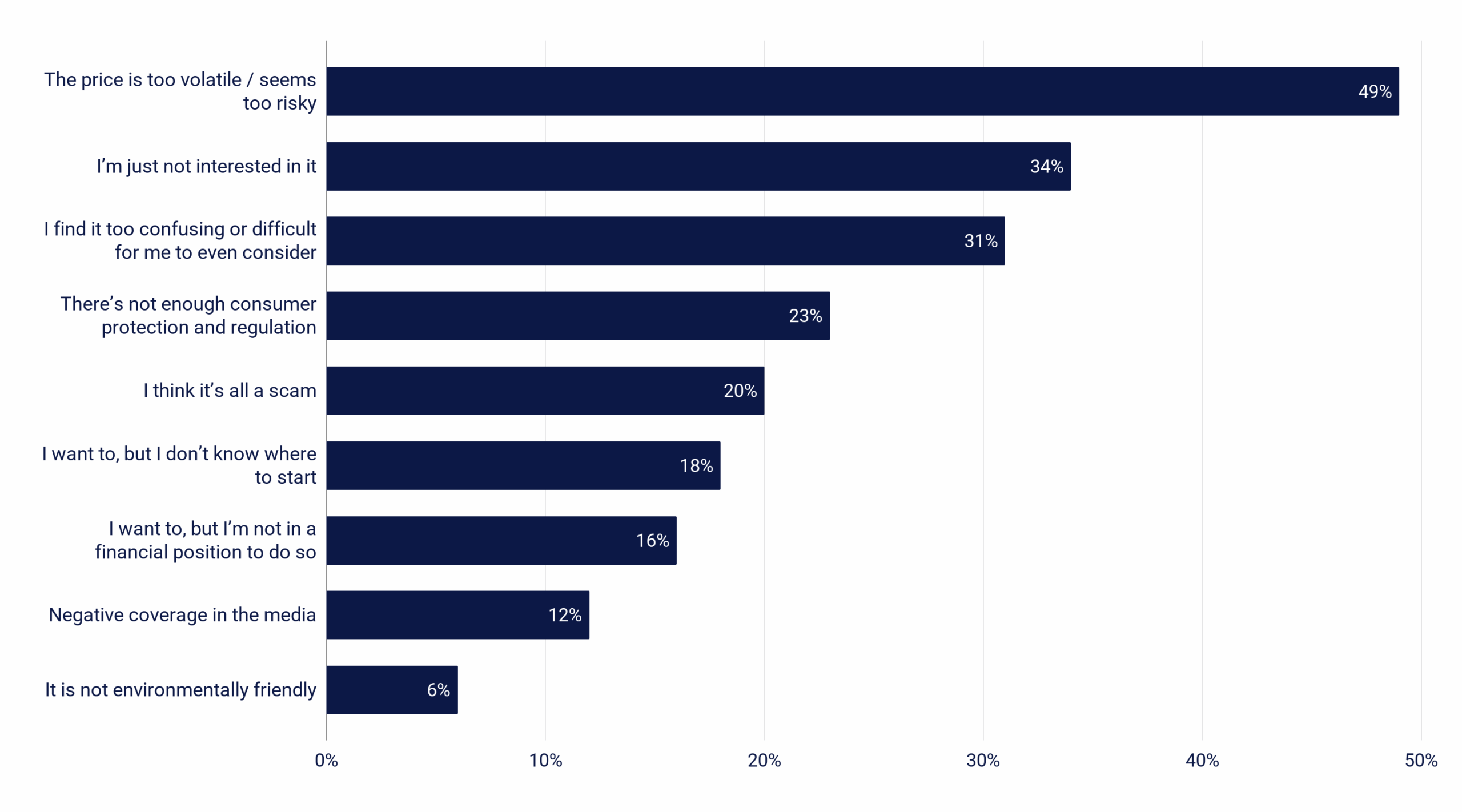
The data suggests that crypto adoption among non-investors is shaped by a layered gap across interest, trust, and understanding. While price volatility is the most cited barrier (49%), price stability is less influential as a motivator to enter the market (31%). Instead, stronger consumer protection (34%) and clearer regulation (33%) emerge as the key drivers of adoption, indicating that trust and safeguards matter more than market conditions.
Receptiveness declines with age. The share of respondents who say nothing would make them invest increases from 19% among Gen Z , 25% for Young Millennials, 36% for Gen X and 47% for Boomers. At the same time, responsiveness to education also drops significantly. Younger groups are more open to crypto but face practical entry barriers, while older groups are more likely to opt out altogether despite being aware of the risks. Among Gen Z, 40% cite lack of funds and 32% do not know where to start, compared to 23% and 11% among Boomers.
Top reasons why Singaporeans don’t invest in crypto
What would make non-crypto investors more inclined to invest?