In markets
The great Bitcoin selloff since mid-January suddenly accelerated this week, with the top cryptocurrency plunging more than US$18k over a few days, including a single-day drop of 13%. It was the largest daily decline since FTX collapsed in 2022, and US$2.6 billion of crypto positions were liquidated in 24 hours. Weekly Google search volume for Bitcoin hit the highest level in a year.
The fact that fundamentals appear to be improving while prices go south has led some to lose faith in the crypto revenue model, including Inversion founder, Santiago R Santos.
On the upside, Bitcoin bounced hard from the lows, surging to US$10.6k shortly after, and it found its way back above the previous cycle’s all-time high. Strategy’s MSTR pumped 31% off the bottom.
The macro picture is uncertain, with US jobs data looking shaky. Some pundits argue that new Fed Chair nominee Kevin Warsh’s comments about a central bank and treasury accord are a plan to inflate away the massive US debt. US inflation figures come out on Friday, and AUD is now buying almost 4c more USD than it did at the start of the year.
Bitcoin mining difficulty dropped by 11.16%, the tenth-largest drop in history, in part due to winter storms disrupting mining in the US and unprofitable miners switching off machines.
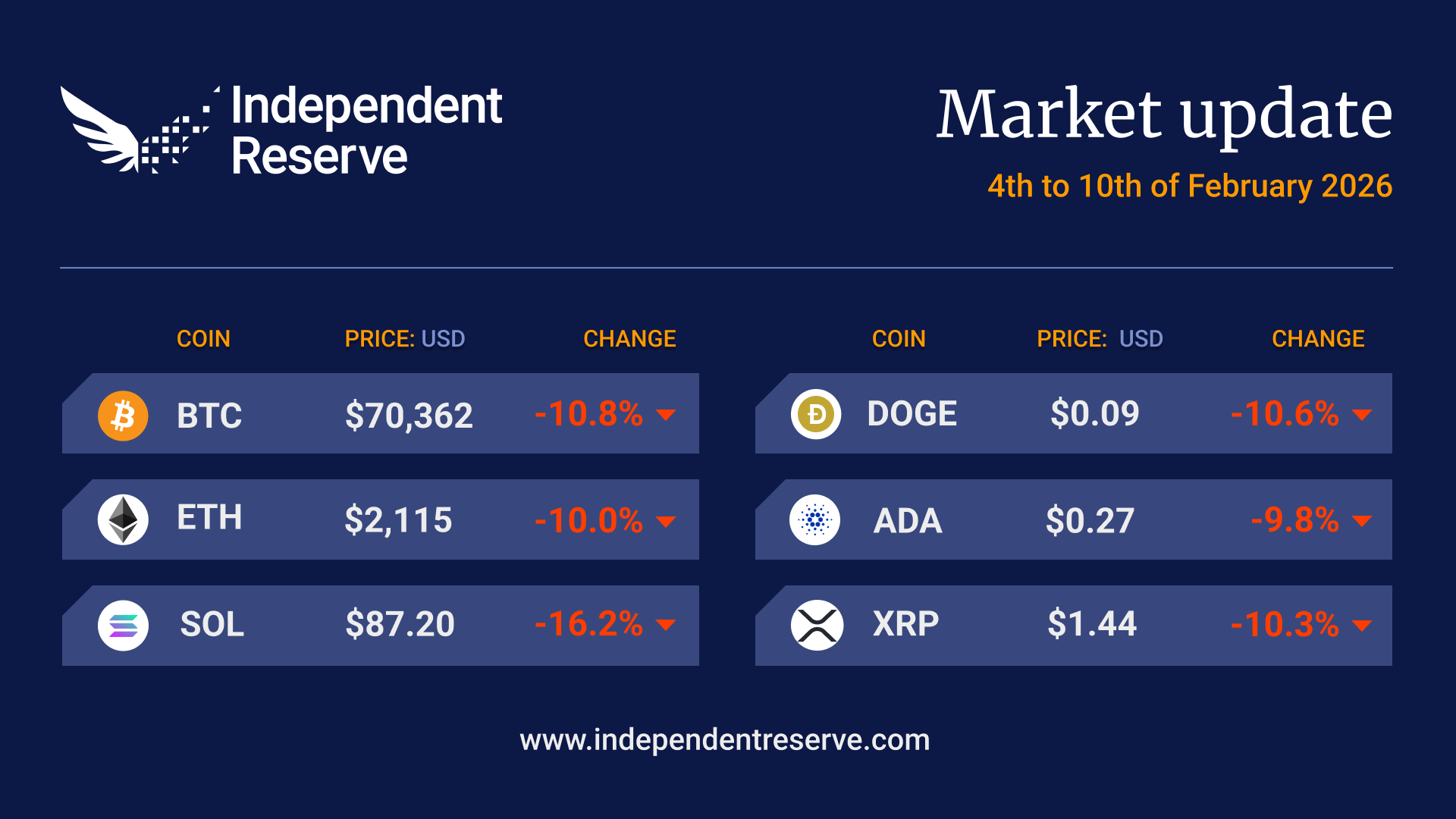
Bitcoin finishes the week down 10.8% to trade around US$70,362, while Ethereum declined 10% from seven days ago to trade around US$2,115. XRP, Dogecoin and Cardano all fell by similar amounts to Bitcoin, but Solana saw a larger decline of 16.2%. The Crypto Fear and Greed Index is at 9, or Extreme Fear.
From the OTC desk
Speedrunning a bear market?
No one can argue that the bull market has ended and that we have officially entered a bearish period. The BTC price has decisively fallen under the previous cycle’s all-time high price of US$69k to tap US$60k on Friday. Price-wise, this isn’t unusual – bear markets typically see the price of Bitcoin trade below the previous cycle high. During the last cycle’s low, the price dropped to US$16k for 2 months, after reaching an all-time high of US$20k.
What is unusual this time is the speed of the move. The market appears to be speed-running this bear phase, which may feel constructive at first glance. However, markets rarely recover sustainably simply because key technical levels have been reached. More often, recoveries require time – time for leverage to reset, sentiment to stabilise, and spot demand to rebuild – before a durable uptrend can emerge.
All eyes on equities
Unsurprisingly, it took less than a day for Bitcoin to rebound back toward the US$70K level, where prices have largely consolidated over the past four sessions. What comes next remains uncertain; however, from the OTC desk’s perspective, equity market performance is now a key variable to watch. With the S&P 500 briefly approaching 7,000 in recent weeks, any sustained weakness in US equities could reintroduce downside pressure across risk assets, including crypto.
OTC desk activity
- Significant trading volumes around the local lows, with dip buyers materially outpacing sellers.
Key Economic Calendar Events (SGT)
- Tuesday, Feb 10 2026 – 09:30 PM – US Retail Sales MoM (Consensus 0.4%)
- Wednesday, Feb 11 2026 – 09:30 AM – CN Inflation Rate YoY (Consensus 0.3%)
- Wednesday, Feb 11 2026 – 09:30 PM – US Unemployment Rate (Consensus 4.4%)
- Thursday, Feb 12 2026 – 03:00 PM – GB GDP Growth Rate YoY (Consensus 1.2%)
- Friday, Feb 13 2026 – 09:30 PM – US Inflation Rate YoY (Consensus 2.5%)
- Monday, Feb 16 2026 – 07:50 AM – JP GDP Growth Rate QoQ (Consensus 0.4%)
In headlines
What caused the selloff?
It was an unusual crash, with no obvious catalyst. One viral theory suggests a Hong Kong hedge fund levered up on Japanese Yen and heavily invested in BlackRock’s IBIT got into trouble after the sharp fall in precious metals and was forced to sell everything at fire-sale prices.
There’s no direct evidence for that, and locals in Hong Kong say they would have probably heard about it. We do know for certain that another Asian firm, Trend Research, sold 658,000 ETH over the course of a week to repay massive loans, and took a US$688M loss.
BitMEX founder Arthur Hayes, meanwhile, suggested that banks such as Morgan Stanley may have been forced to sell Bitcoin to hedge their exposure in structured notes tied to IBIT. When Bitcoin falls sharply, automated systems sell more Bitcoin to maintain the hedge (“delta hedging”), accelerating the drop.
Regardless of the specific cause, big drops are common in crypto markets. BitMine’s Tom Lee points out that since 2018, Ethereum has seen a drawdown of 60% or worse seven times. “This is basically every year,” he said.

Japan’s crypto industry faces critical test
Japan’s Prime Minister Sanae Takaichi is seeking to turn strong personal approval ratings into a parliamentary majority that could accelerate major changes, including cutting crypto taxes, reclassifying more than 100 tokens as financial products, and launching crypto ETFs by 2028.
Industry leaders are expecting faster progress under a decisive coalition win, but slower implementation if results are fragmented. Although support for crypto reform is broadly embedded across major parties and regulators, analysts warn that a shift toward populist leadership could weaken Japan’s position in the global digital asset market.
Asian crypto news
Vietnam is preparing to introduce a tax framework for digital assets that treats them as securities and imposes a 0.1% tax on each transaction. A fat-fingered intern at Bithumb accidentally selected BTC instead of Korean Won, and inadvertently sent hundreds of users 2,000 Bitcoin each rather than 2,000 KRW (US$1.37). While many found it funny, others wondered how the exchange could send 15X more Bitcoin than it actually held in its wallets.
Second White House meeting of banks and crypto
The White House has scheduled a second Clarity Act meeting today with policy staff from the big banks (JPMorgan, Wells Fargo, Bank of America) and crypto industry trade groups, including the Blockchain Association. They’re trying to find a compromise on the big block of the bill, which would allow stablecoin yield for crypto firms. Senator Kirsten Gillibrand told CNBC that Democrats are open to negotiating amendments to pass the bill. Treasury Secretary Scott Bessent told the Senate, “It is vital that the CLARITY Act is signed into law,” and posted that ”I am confident that with leadership from both sides of the aisle, we can get this across the finish line.” Decrypt reported sources claiming that Senator Chuck Schumer is “very desperate” to get the bill over the line after the crypto industry raised a US$193M war chest to fight this year’s mid-term elections this year.

Other regulatory news
The CFTC has clarified that national trust banks are eligible to issue fiat-pegged stablecoins under the Genius Act. The consultation period on a proposal to give fintech firms limited access to the Fed’s payments infrastructure (skinny master accounts”) has ended. No surprise that crypto companies are largely in favour, while some banking groups are opposed.
Rollups no longer centric to roadmap
Ethereum creator Vitalik Buterin introduced the Rollup-Centric Roadmap in 2020, and this week he overhauled it, saying “the original vision of L2s and their role in Ethereum no longer makes sense, and we need a new path.” Going forward, the roadmap will be more focused on scaling the L1 with ZK proofs, given the L2s seem to have no interest in moving to stage 2 decentralisation. He suggested L2s needed to specialise and offer something different and unique to the L1. He also threw his weight behind Native Rollups, which are essentially a new spin on the old ETH 2.0 sharding plan and offer the same security as L1, plus synchronous composability across rollups. On the weekend, the Etherem Naming System v2 cancelled its plans for an L2 and announced it would deploy exclusively on Ethereum L1.

Strategy’s quarterly results
Strategy reported a net loss of US$42.93 per share in the fourth quarter. It saw an operating loss of US$17.4B for the quarter, which doesn’t even include the past five weeks of decline. Meanwhile, Tom Lee’s BitMine has a US$7.6B paper loss on its ETH holdings, but bought another 40,613 ETH this week.
Bitcoin ETFs
Thursday saw a record US$10B in trading volume for BlackRock’s Bitcoin ETF, and TradFi stepped in to buy the dip on Friday with US$330.7M of inflows. Bloomberg’s Eric Balchunas points out the ETFs still have 90% of AUM “hanging tough.”
Where to next?
Bitcoin has closed a third week below the 100-week moving average. Analyst Nicrypto said that, typically, after this happens, it stays, on average, below for 267 days, with the shortest spell being 34 days during the Covid flash crash. However, Bitwise CIO Matt Houghan says the drawdown is structurally different to 2022, with no signs of systemic stress to crypto infrastructure. He believes markets are near the bottom and “much of the bad news is already priced in.” Bloomberg analyst Eric Balchunas pointed out that both stocks and Bitcoin “have a 100% perfect record of coming back from beatdowns to hit new ATHs.”
Until next week, happy trading!