We’re pleased to share that Independent Reserve has been named a finalist for six awards at this year’s Digis, the industry awards run by the Digital Economy Council of Australia (DECA). Our nominations are: Company of the Year, Digital Currency Exchange of the Year, Product & Service Innovation, Data, AI & Intelligence, Engagement & Education, and Customer Experience Excellence. A huge thank you to our clients and community. Your support is what drives us to keep raising the bar.
Market insights
Concerns over the sustainability and financing of the projected US$10 trillion AI buildout in the US, which will equate to a larger share of GDP than building the railroads, contributed to a 5.5% fall in the Nasdaq 100 last week. It was the largest weekly decline since April 2025. Social media fears of a Black Monday-style rout pushed Bitcoin down to around US$80,000, but it recovered more than US$2,000 as the Nasdaq 100 rallied 1.2%.
Long-dated oil futures have risen sharply, and the US has reportedly conducted a strike on Iran’s Konarak naval base. The Iranians, meanwhile, are attacking dozens of ships each week in the Strait as they reportedly seek to make the impending mid-term elections as uncomfortable as possible for Donald Trump.
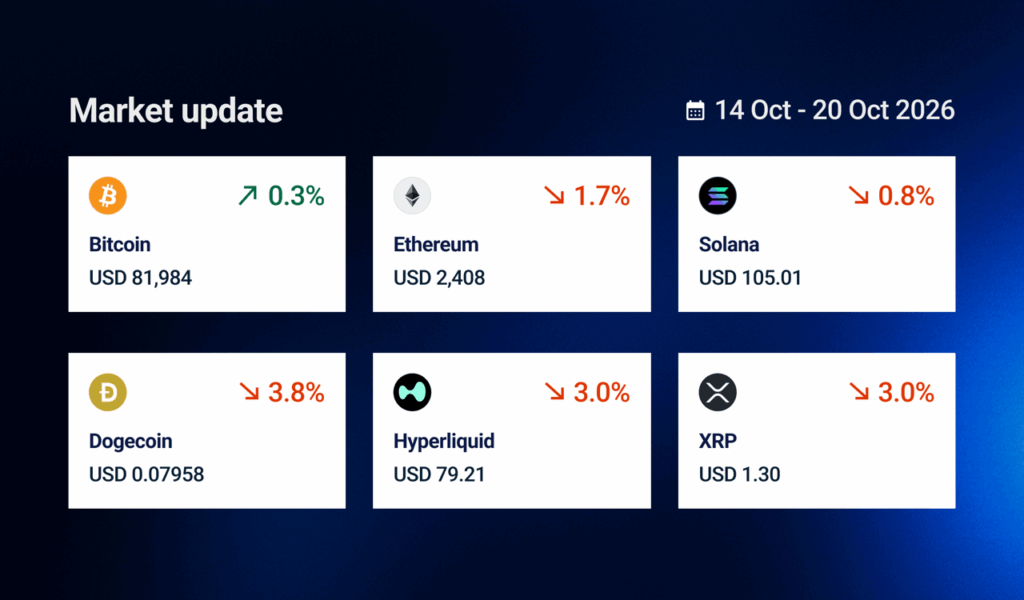
Bitcoin finishes the week flat at US$81,984, while Ether loses 1.7% and trades around US$2,408. XRP erased 3%, Solana fell 0.8%, Hyperliquid lost 3%, and Dogecoin lost 3.8%.
US Bitcoin ETFs saw US$228.6 million in outflows last week, while Ether ETFs saw US$320 million in outflows.
ETH’s relative underperformance since The Merge in 2022 looks even worse when you consider that ETH’s supply has reportedly increased by only 1% since then, while Bitcoin’s supply grew 4.96% and SOL’s grew 66%.
The Crypto Fear and Greed Index is at 59, or Greed.
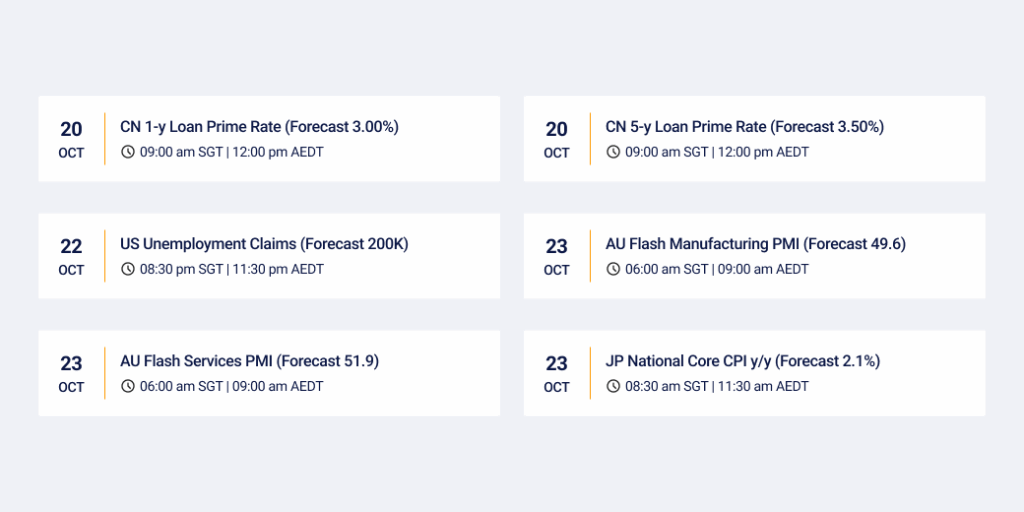
Key economic calendar events
In headlines
Australia preps for new crypto rules
ASIC has opened consultation on proposed capital, custody and trading requirements for crypto platforms. The proposals include restrictions on platforms trading for their own accounts or accepting benefits that favour particular tokens, quarterly reporting on wallets that hold customer assets, and three alternative capital models for digital asset platforms. There is also greater clarity on licensing requirements and how to safeguard customer assets, with the new regime expected to begin in April 2027. Treasury has also released draft legislation to adopt the OECD’s Crypto Asset Reporting Framework. It would require exchanges to report customer transactions directly to the ATO from July 2027.
The institutions are here
America’s largest bank JPMorgan, has launched JPM Coin’s bank deposit token on Ethereum to allow institutional clients to transfer money 24/7. Germany’s largest bank, Deutsche Bank is prepping to offer institutional custody of Bitcoin and Ether. Germany’s Sparkassen savings bank has launched crypto trading in its app. Blockchain verification project World, founded by OpenAI CEO Sam Altman, has launched a version of World ID built for banks and financial firms. The joint stock token trading venture between OKX and Intercontinental Exchange hit a minor snag after nine companies objected to its plans to tokenise their stocks. However, it still intends to launch trading with more than 50 tokenised stocks.
Tampered Ledgers disaster
Ledger has suspended sales from its resellers across Indonesia, Singapore, Thailand, the Philippines, Vietnam, Malaysia and Hong Kong. The move comes after around US$100 million was stolen from Ledgers with spyware implants. The European chain MediaMark has also suspended sales, and Trezor has proactively decided to shrink its own reseller network. Former Mt Gox CEO Mark Karpeles criticised Ledger, claiming it had been made aware of tampered Ledgers as early as December 2025, with further reports in March, but did not take appropriate action. Ledger decided this was the opportune moment to unveil its new supposedly tamper-proof smartphone-like wallet called Atom, which costs US$849.
Strategy set to be dropped from indexes
Strategy stock plunged almost 10% on Friday after index provider MSCI adopted new rules that look set to oust the Bitcoin treasury company from its indexes. The methodology makes “non-operating companies” ineligible for inclusion, which will likely affect other treasuries like Sharplink and Metaplanet, too. Strategy claims that the relevant indexes account for only 3.1% of its basic shares outstanding, or around $1.8 billion. Getting kicked off the indexes would not, in itself, require it to sell Bitcoin. The final list is due November 11. MSCI also caused chaos in Indonesian markets by warning it could strip the country of “emerging market” status.
Ethereum upgrade coming soon
A dress rehearsal for Ethereum’s Glamsterdam fork hits the Hoodi testnet early next Tuesday. If all goes well, expect to see mainnet activation sometime around December, increasing network capacity by 3.3X. There was another big breakthrough for the ETH roadmap this week, with ZKSync announcing it has achieved real-time ZK proving of blocks using a single GPU. In the future, validators will simply check tiny ZK proofs, rather than re-execute transactions, dramatically speeding up the chain. Creator Vitalik Buterin has also been pushing for “EIP-8288 maximalism” referring to a proposal that would push computation off-chain using ZK STARKS, enabling post-quantum signatures without adding precompiles.

Solana’s Alpenglow upgrade
Solana will see its biggest ever upgrade early Thursday morning, around 2AM AEDT. Alpenglow changes the voting system that Solana’s validators have used since launch. The new system will make finality 85X faster, targeting just 150 milliseconds versus 12.8 seconds today (that’s how long you will have to wait until a transaction can’t be reversed). Validator votes have been inflating Solana’s headline TPS by more than half for a while now, and Milk Road says users should “Expect scary ‘Solana activity collapsed’ headlines… The reported numbers will drop even though nothing broke.”
Singapore crypto news
Crypto scam losses in Singapore have fallen 43% year over year to US$49.95 million, attributed to stronger enforcement, industry partnerships, and better public education. A new report from Chainalysis says that Singapore accounts for 18.2% of geolocated tokenised US treasuries, just behind Italy and Portugal. Network School has acquired social media platform Farcaster, with founder Balaji Srinivasan saying he hopes to turn it into “the Singapore of social media”, a community of techno-optimists that operates under a shared code of conduct.
QDay gets closer again
Google has demonstrated a new “magic state cultivation” technique for quantum computers that reduces errors 40-fold. Theta Labs claims it has reduced the number of qubits required to break Bitcoin and Ethereum’s elliptic-curve cryptography by more than a quarter, compared with Google’s previous estimate. ETH L2 StarkWare says the danger from AI and quantum computers is now so acute that it can’t wait for Ethereum to become quantum safe, and it’s voting on becoming a post-quantum L1. There’s a furious debate over whether lattice cryptography (used by Near and Midnight and supported by a16z is more vulnerable to quantum computers than the hash-based cryptography favoured by Ethereum and Bitcoin. TLDR: lattices have more structure than hashes in the form of algebraic equations, which creates a larger attack surface.
CryptoCon Sydney is coming up on 28 – 29 November at ICC Sydney, Australia’s flagship crypto, blockchain and Web3 event. Get your free ticket here.
Until next week, happy trading.