AI-powered news, built into the IR app
Telescope.ai, Independent Reserve’s AI-powered feature, is now available to all customers. It delivers personalised news summaries, portfolio insights, and asset-level insights, all tailored to your activity and holdings.
Market insights
Confidence in crypto was shaken this week, first by concerns that AI could one day break public key encryption, and then by a supply chain attack targeting Ledger products sold in Asia and Europe.
The macro picture is darkening too, with the conflict in the Middle East heating up, Brent crude oil crossing US$107 a barrel, and the debt problem worsening in France.
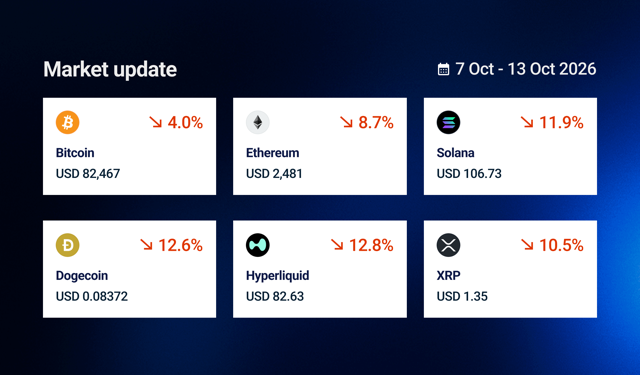
As a result, ‘Uptober’ has not lived up to its name so far, and Bitcoin fell by another 4% this week, trading around US$82,467. Ethereum lost 8.7% to trade around $2,481, Ripple lost 10.5%, and Solana dropped 11.9%. Hyperliquid fell 12.8%, and Dogecoin lost 12.6%.
The Bitcoin ETFs saw outflows of US$681.1M last week, while the ETH ETFs saw outflows of US$542.1M.
It was also the one-year anniversary of the October 10 flash crash, when US$19 billion of leverage was wiped out in a single day. Bitcoin remains 30% below its 2025 peak, and the Bitcoin ETFs are still negative if measured from the crash.
But many believe the bear market is now behind us, and a State Street survey of 300 asset managers found that 51% expect digital assets to become mainstream in the next five years. Retail adoption is also picking up, and this month, Samsung Wallet will allow 82 million US Galaxy users to send USDC to crypto wallets and bank accounts in 60 countries.
The Crypto Fear and Greed Index is at 69, or Fear.
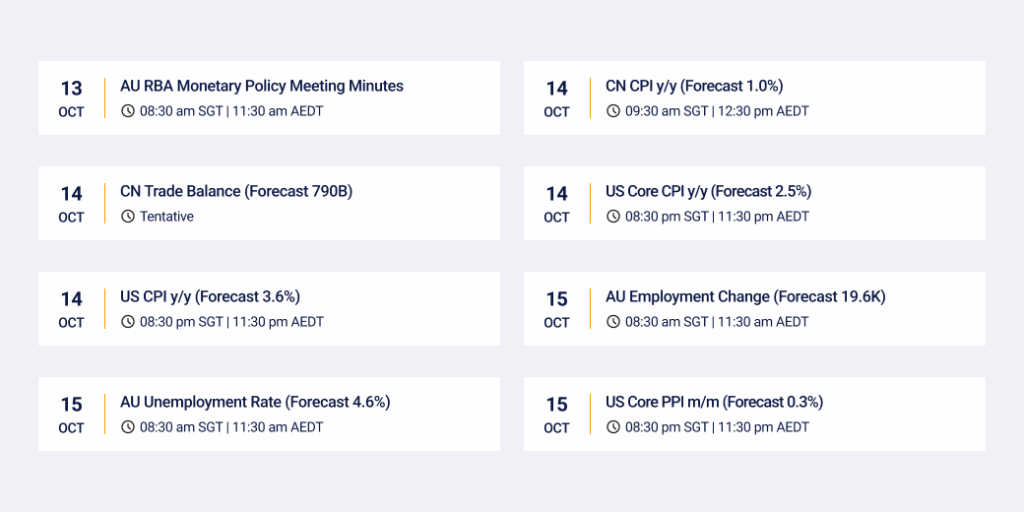
Key economic calendar events
In headlines
IR adds cross-border payments, ReserveX launches derivatives
Independent Reserve has added cross-border payment tools, enabling businesses in Singapore to make fiat or stablecoin payments to overseas suppliers or employees. Accounts can be funded in Singapore or US dollars, and payments made in more than 20 currencies, as well as USDC and USDT. Crypto derivatives trading for sophisticated investors has also just launched via IR Group’s subsidiary ReserveX.
Ledger supply chain attack
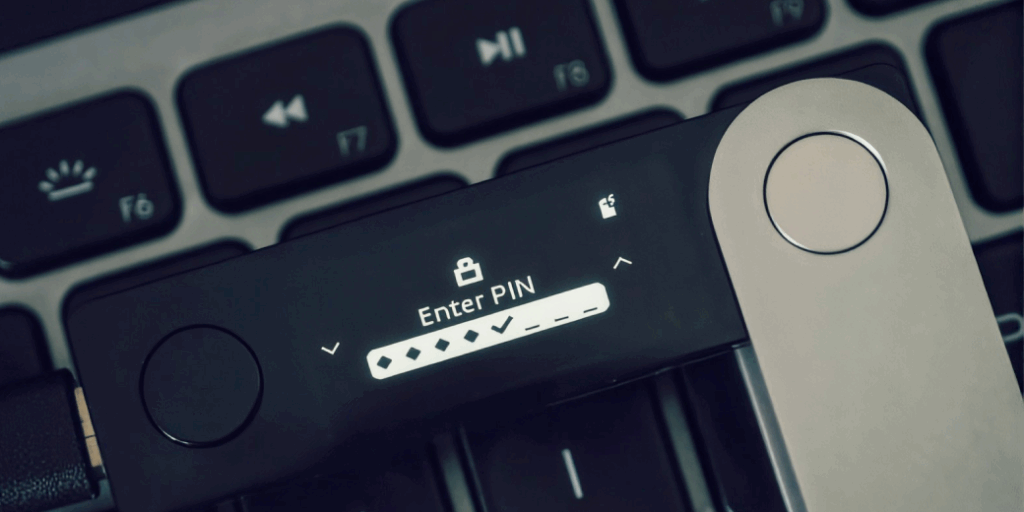
Former Mt Gox CEO Mark Karpeles last week posted photos of circuitry and a SIM hidden inside a Ledger Nano X that records seed phrases while still passing an authenticity check. The discovery appears to have prompted the attackers to sweep US$103.4 million from 530 affected wallets across seven different chains. Most of the devices came from CryptoBilis, a reseller servicing Indonesia, Malaysia, and the Philippines. It was recently sold, with the new owners requesting an NDA, so the transfer of ownership was not disclosed. Ledger said yesterday that the confirmed attacks were all connected to CryptoBilis, and a user has also reported tampered devices being sold in European electronics chain stores.
Could AI break crypto?
Ethereum researcher Justin Drake warned last week that the risk of AI breaking cryptography was now so high that the industry needed to go into “bunker mode” and shift funds to new addresses where public keys are not exposed. The controversial warning was prompted by OpenAI’s release of potential solutions to 377 math problems that humans have been unable to solve. Ethereum founder Vitalik Buterin cautioned users against hastily moving funds due to the risks, but shares Drake’s concern that elliptic-curve and lattice-based cryptography could be vulnerable to AI. Ethereum and Bitcoin researchers believe hash-based cryptography will survive, although ADA’s Charles Hoskinson disagrees that the lattice is at risk. Critics say there is no evidence to support concerns about an imminent break. Even if the worst came to pass, each crypto address would need to be cracked individually, giving chains time to implement emergency hard forks and recovery procedures already being developed for post-quantum risks.
AI may have just saved XRP investors US$94B
AI analysis of the software that runs the XRP Ledger discovered two low-severity bugs and found that, if chained together, they could allow an attacker to print 18.4 trillion XRP out of thin air. The security flaw has been hidden in the code since 2015 and was discovered by Veria Labs, which was paid a US$250,000 bug bounty for doing so. Co-founder Cayden Liao said the bug had put XRP’s entire market cap of “US$94B at risk, more than 60 times the largest crypto hack on record.” The bugs were patched three days after being reported on September 22, and there was no evidence that they were ever exploited. Meanwhile, Ripple Prime has announced it will provide prime brokerage, clearing and financing services to hedge fund Brevan Howard and received a nice write-up in the Wall Street Journal. Standard Chartered is also launching an institutional custody service for Ripple’s RLUSD stablecoin.
US$50B flowed into crypto this year
JPMorgan estimates that $50 billion has flowed into crypto this year. That equates to an annual haul of $66 billion, about half of last year’s figure but still the third-best annual result to date. The figure includes flows from crypto funds, treasuries, VCs, miners and others.
ASIC to extend CFD rules to include crypto
The Australian Securities and Investments Commission has proposed extending leverage limits and other retail investor safeguards to Contracts For Difference (CFDs) settled in crypto. The current rules from 2021 cover contracts settled in cash. ASIC said that certain crypto futures and options with fixed expiry dates would remain outside the CFD rules.
Bitmine won’t buy any more ETH after 5%
Bitmine has just crossed the six-million ETH mark in its treasury, which equates to 4.9% of the entire ETH supply. Chair Tom Lee announced at Token2049 that Bitmine will stop buying when it hits 5%, removing one of the biggest weekly buyers of ETH since mid-2025. Lee believes ETH will peak around US$25K to US$50K in 2027. He also believes that tokenisation, DATs, AI, wealth transfers and institutional money could make this “the largest ever crypto bull market.”
Singapore news
MAS managing director Chia Der Jiun said the foundational capabilities of blockchain and digital assets have already been proven, with the focus now on commercial viability and trust. As AI agents increasingly work with tokenised assets and digital money, they can execute trades autonomously, so money could move faster “for smaller differences in benefits and incentives”. Financial institutions will thus have to “sharpen their value proposition”. He also noted this acceleration has implications for risk management, particularly concerning liquidity and collateral. Meanwhile, a survey of 291 investment decision makers in Singapore found that 91% want to earn additional returns without selling their Bitcoin.
Until next week, happy trading.