Market insights
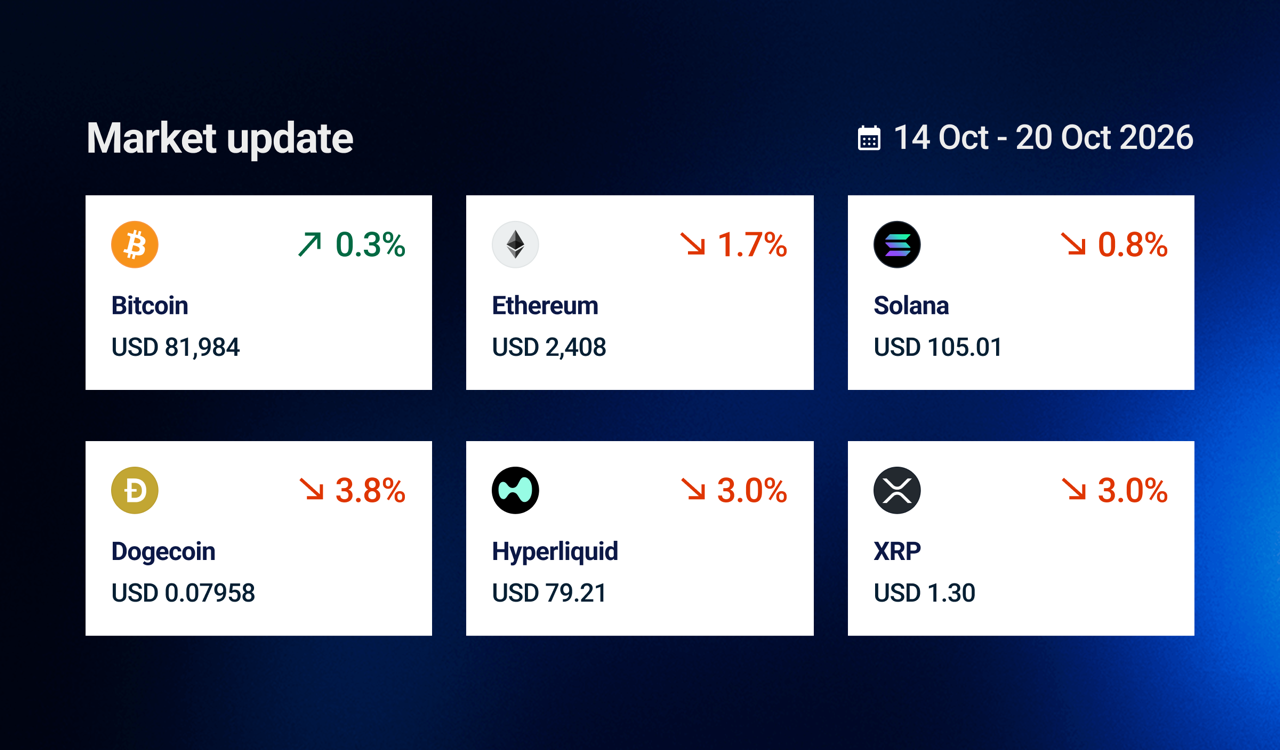
With an escalation of the Iran-US conflict looking increasingly likely, Bitcoin took a dive below the US$80K mark over the weekend.
Anthropic has also just announced what could be the world’s largest IPO, which could attract additional funds from crypto. Bitcoin and gold are already 2026’s worst-performing major assets, down 7.3% and 7.5% respectively, while the AI driven stock-market has risen 52.5%.
But in the long run, BNB Chain founder CZ argues that “crypto is going to be the native currency for AI.”
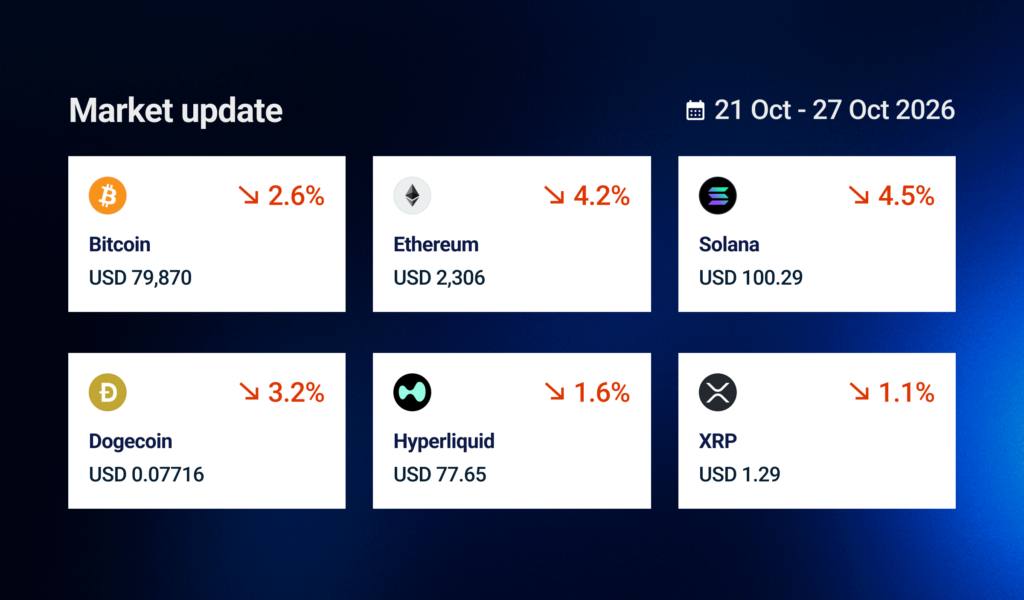
Bitcoin finished that week down 2.6% to US$79,870, while Ethereum lost 4.2% to trade around US$2,306. XRP was flat, Solana lost 3.8%, Hype fell 1.6%, and Dogecoin lost 3.2%.
Maelstrom Capital’s Arthur Hayes sold off almost US$30 million of ETH, ENA and UNI, citing “dicey” geopolitical and macro factors. “I think we gotta go down to go up,” he said.
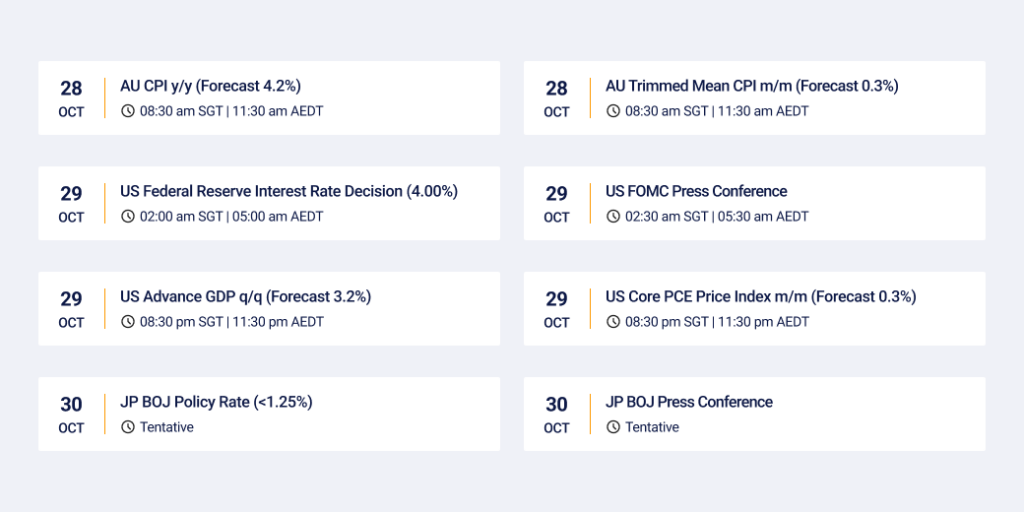
The next week or so could be bumpy due to elections in the US and Israel, interest rate decisions in the US, Japan and UK, and earnings figures from big tech companies, including Google and Microsoft.
But a Galaxy Research report says the big picture looks promising, the bear market ended in June, sellers are largely absent, and the accumulation phase is underway. “We believe now is an attractive time to buy and hold Bitcoin,” the report concluded.
The Crypto Fear and Greed Index is at 50 or neutral.
Key economic calendar events
In headlines
JPMorgan expects a 10% annual BTC return over the next decade
J.P. Morgan Asset Management expects Bitcoin will average a 10% annual return over the next ten years, beating stocks (7.5%), real estate investment trusts (8.2%) and gold (5.5%). However, its 2027 Long-Term Capital Market Assumptions report adds that Bitcoin’s 55% annualised volatility makes it unsuitable for inclusion in its core portfolio allocation models.

Ethereum hard fork delayed
Ethereum’s core devs have cancelled this week’s dress rehearsal of the Glamsterdam fork on the Hoodi testnet after ChainSecurity discovered security issues related to the gas accounting changes in EIP-8037 and EIP-8038. A new testnet date is yet to be announced. Ethlabs reports that teams of AI Agents are scanning smart contracts to look for other unexpected downstream effects of the fork. They are coordinating efforts via a GitHub message board, similar to the Hugging Face hack. The AI audit has been so successful that it’s already being employed to test the “quick slots” EIP proposed for the subsequent Hegota hard fork. Ethereum’s fork delays are nothing new, with Constantinople, Dencun and Pectra all delayed over a surfeit of caution to help maintain ETH’s 100% uptime record.
US midterm elections
Polling suggests that control of the currently pro-crypto Congress is set to fall to the crypto-sceptical Democrats after the November 3 US midterm elections. The Democrats may also win the Senate, although the filibuster rule (which requires 60 of 100 votes to overcome) means they’re unlikely to take full control. The top Democrat on the Senate’s investigations subcommittee, Senator Richard Blumenthal, this week demanded a raft of documents from Tether related to allegations that it had paid US$6.3 million to former White House Advisor Bo Hines’ company. More investigations into the White House’s links with crypto after the election are a definite possibility. However, Schwab’s director of equity research, Adam Lynch, doesn’t expect a Democrat sweep to hit “crypto as much as people expect” and says “gridlock tends to be a positive thing”. US stocks historically take a dive following mid-term elections, but recover within about 6 months.

Keystone forced to destroy hardware wallets
Keystone will destroy 18,835 hardware wallets after attackers stole the cryptographic key it uses to authenticate devices. The attackers also made off with 25,964 customer records and 12,873 abandoned check-out records. Devices delivered before October 20 remain unaffected, it said. The breach is another blow for hardware wallets in 2026, following huge losses from the Coldcard and Ledger thefts, and data leaks from Trezor and Safepal.
Bitcoin ETFs turn a corner
The Bitcoin ETFs hauled in US$304.7 million last week, snapping a two-week outflow streak, while the Ether ETFs lost another US$220.6 million. The ETH ETFs have seen outflows on all but two days this month, totalling US$1.2 billion. With Bitmine also about to cease its weekly purchases, Unchained asks who will step in to buy and support the price? Franklin Templeton has just registered two new ETFs on the Nasdaq: the US Equity Bitcoin DRIP Index ETF and the US Innovation Bitcoin DRIP Index ETF. Both comprise around 95% stocks and 5% Bitcoin, and use dividends to acquire more Bitcoin through the year, rebalancing each quarter. The mix is aimed at attracting cautious investors who want some exposure to Bitcoin, but not too much.
US regulation news
Crypto in America reports that there has been considerable debate in SEC submissions about the definition of a “public and permissionless” network in relation to tokenised stock trading. Is Canton decentralised, or the Ethereum L2s? The Solana Policy Institute, Columbia professor Omid Malekan, and lawyer Gabriel Shapiro have all argued that the SEC’s innovation exemption should apply only to genuinely decentralised chains. However, the SEC told the publication it’s taking a hands-off approach and wants the market to decide which blockchain models work. A number of banking organisations have also complained that the OCC’s new rules to implement the GENIUS stablecoin act don’t include additional restrictions on stablecoin rewards.
Malaysia and Thailand join Singapore’s BLOOM
The central banks of Malaysia and Thailand are joining Singapore’s BLOOM cross-border digital money initiative. The Monetary Authority of Singapore said Bank Negara Malaysia and the Bank of Thailand have joined as policymaker members. Other participants include Ripple, Visa, Mastercard, the World Bank Group, Circle, Coinbase, JPMorgan, Standard Chartered, and Stripe. BLOOM began in October last year as a public-private initiative to test settlement using tokenised bank money and regulated stablecoins. Meanwhile, the Singapore-backed BIT Asset Management (formerly Matrixport) has won approval to launch Switzerland’s first spot Bitcoin ETF.
Until next week, happy trading.