Market insights
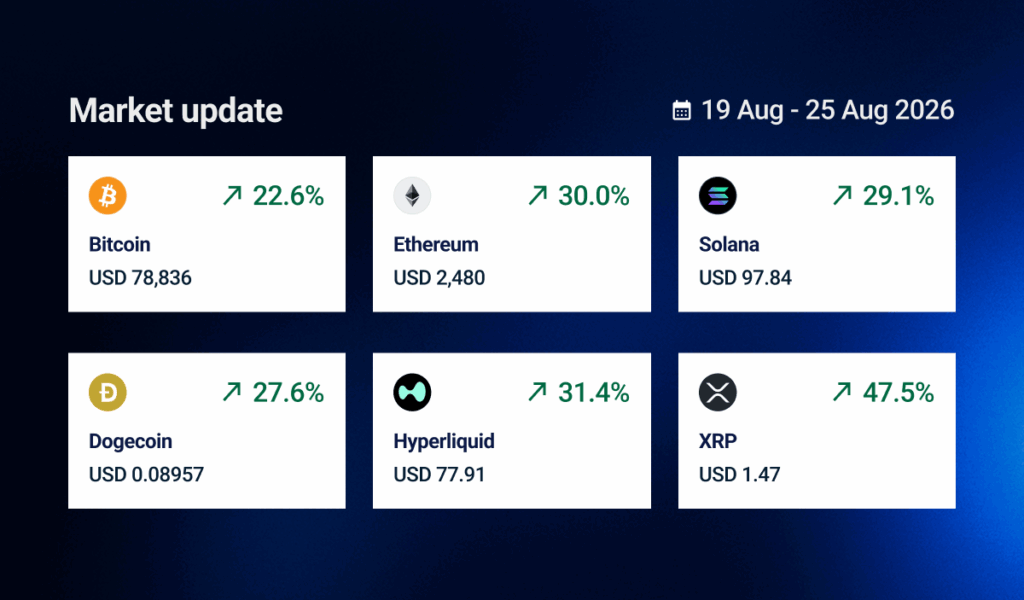
Crypto markets roared back to life this week as Bitcoin surged by US$15,000 in under two days. It finished the week up 22.6% for BTC’s best weekly gain in three years and the highest-ever US dollar value increase. It was a dramatic demonstration of Bitcoin’s “rule of ten days”, which refers to the fact that historically, if you held Bitcoin only on its ten best days each year, you’d see an average 162% gain, while holding it during the other 355 days would see an average loss of 14%. Overnight, Bitcoin touched the US$80K mark for the first time in 113 days, and debate has begun in earnest about whether it marks the start of a new cycle. Bitcoin is currently trading at US$78,836.
Prior to the move, volatility had reduced to lower levels than all but 1.5% of Bitcoin’s history. That set up the conditions for a massive short squeeze, apparently triggered by the US Treasury announcement that it was doubling bond buybacks to US$4 billion per operation in an attempt to reduce high yields. So far, it hasn’t worked, meaning much more firepower is expected to be deployed. This has reportedly revived the so-called debasement trade. Bitcoin surged back above the 200-week moving average, a key indicator of trend reversals, meaning that Strategy is back in profit on its average buy price. Ethereum has now added the equivalent of Solana’s entire market cap, with a 30% surge to US$2,480 for the week.
XRP is up 47.5% for the week, Solana is up 29.1%, and Hyperliquid is up 31.4%, helped along by President Trump’s announcement that the CFTC is working to bring it to regulated US markets. The US is also about to embark on an all-out economic war against Iran, which some argue could benefit assets like crypto that are outside of US control.
The Crypto Fear and Greed Index has surged to 73, or Greed.
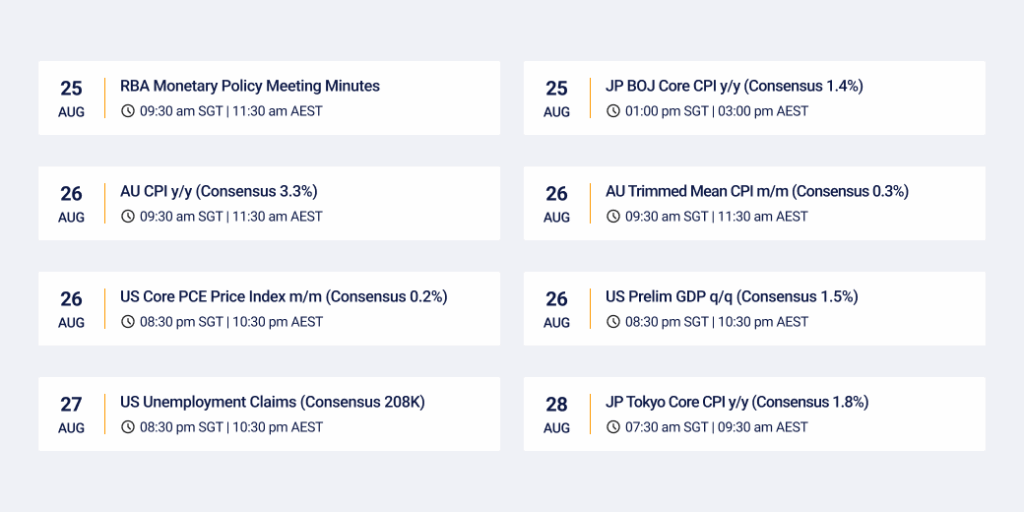
Key economic calendar events
In headlines
US debt policy
US debt crossed the US$40 trillion mark this week, and the interest bill is now the second-largest item in the Government’s budget. In an attempt to bring yields down, the Treasury has begun buying back its own bonds. Overnight, CNBC reported it may use the US$950 billion general account to do so. While this isn’t money printing per se, BiMEX founder Arthur Hayes says it will add more liquidity to the system to chase a finite amount of assets. He says that if yield curve control is coming, “the price of Bitcoin is going to be in the hundreds of thousands very quickly.” Billionaire Ray Dalio, meanwhile, believes the US may see a debt crisis within one to five years and advises investors to put 15% of their portfolio into buying gold and a “bit of Bitcoin.” Australia’s debt crossed US$1 trillion this week, but at just 32% of GDP, it’s well below Germany (70%), the US (125%) and Japan (250%).
Bitcoin and Ether ETFs
The US spot Bitcoin and Ether ETFs saw their best inflows since October 2025, attracting US$2.61 billion between them. The Bitcoin ETFs saw US$1.92 billion in inflows, which Galaxy Research says is the 18th-best week since launch in January 2024. The Ether ETFs took US$697 million.
White House crypto meeting
There’s a renewed sense of optimism among crypto executives that the Trump administration is committed to getting CLARITY over the line following a meeting at the White House this week. After the meeting, President Trump pointedly urged lawmakers to pass a “fair version” of the bill, likely referring to the ethics provisions aimed at his crypto earnings. Democrat Senator Ruben Gallego, who co-wrote the ethics counterproposal under consideration, commented. “I think, unfortunately, what the President means is fair to him,” he said, “The president doesn’t just get to decide what level of regulation he gets.“ Crypto In America reports sources claiming that behind closed doors, a concerted effort is underway to convince Trump “that accepting certain elements of the proposed ethics deal could ultimately be in the President’s own interest.”
SEC proposes new token sale exemptions
The SEC has released its long-awaited proposal for Regulation Crypto Assets, which some hope may spark a new ICO boom. The proposals would enable start-ups to raise up to US$5 million via token sales over four years without full SEC registration. A separate exemption would enable US-based issuers to raise up to US$75 million during a 12-month period while meeting ongoing reporting requirements and disclosing project tokenomics, smart contracts, and source code. There’s also an investment contract “safe harbour” proposal that exempts issuers from securities rules, provided certain conditions are met. The proposal is open for comment for 60 days.
CFTC to issue its own rules as well
CFTC (Commodity Futures Trading Commission) chair Mike Selig says the regulator will issue its own rules if lawmakers can’t agree to pass CLARITY. “If CLARITY continues to stall because of Democratic obstruction, the CFTC will utilise its existing authorities to begin establishing a regime for crypto asset markets,” he said. He made the comments during the first meeting of the CFTC’s new Innovation Advisory Committee, which includes 43 representatives from firms including Coinbase, Kraken, Robinhood, Nasdaq, NYSE and CME.
Pressure ramps up
Stand With Crypto has announced it will endorse and support the 32 pro-crypto politicians in the upcoming US midterm elections, with millions of dollars in spending. The move adds to growing pressure from the White House, CFTC and SEC. It isn’t announcing which candidates it will back in Senate races just yet, which will ramp up pressure on Senators to vote for the CLARITY Act in September.
Singapore and Hong Kong’s tax battle
Asia’s two most important crypto hubs, Singapore and Hong Kong, are locked in a tax-cutting arms race aimed at asset managers. The Monetary Authority of Singapore (MAS) this week announced it will exempt certain investment profits from taxation for fund managers, including those running single-family office funds. The move comes two months after Hong Kong issued a new bill to cut taxes for hedge funds, although MAS Deputy Chairman Chee Hong Tat emphasised that it is not a “zero-sum game” between the two financial hubs. Singapore is also expanding a scheme that helps investment professionals relocate to the city-state and is offering a co-investment scheme between MAS and fund managers who base operations in Singapore. Meanwhile, Standard Chartered has become the first bank authorised to distribute the new regulated Hong Kong dollar stablecoin called HKDAP.
Until next week, happy trading.