In markets
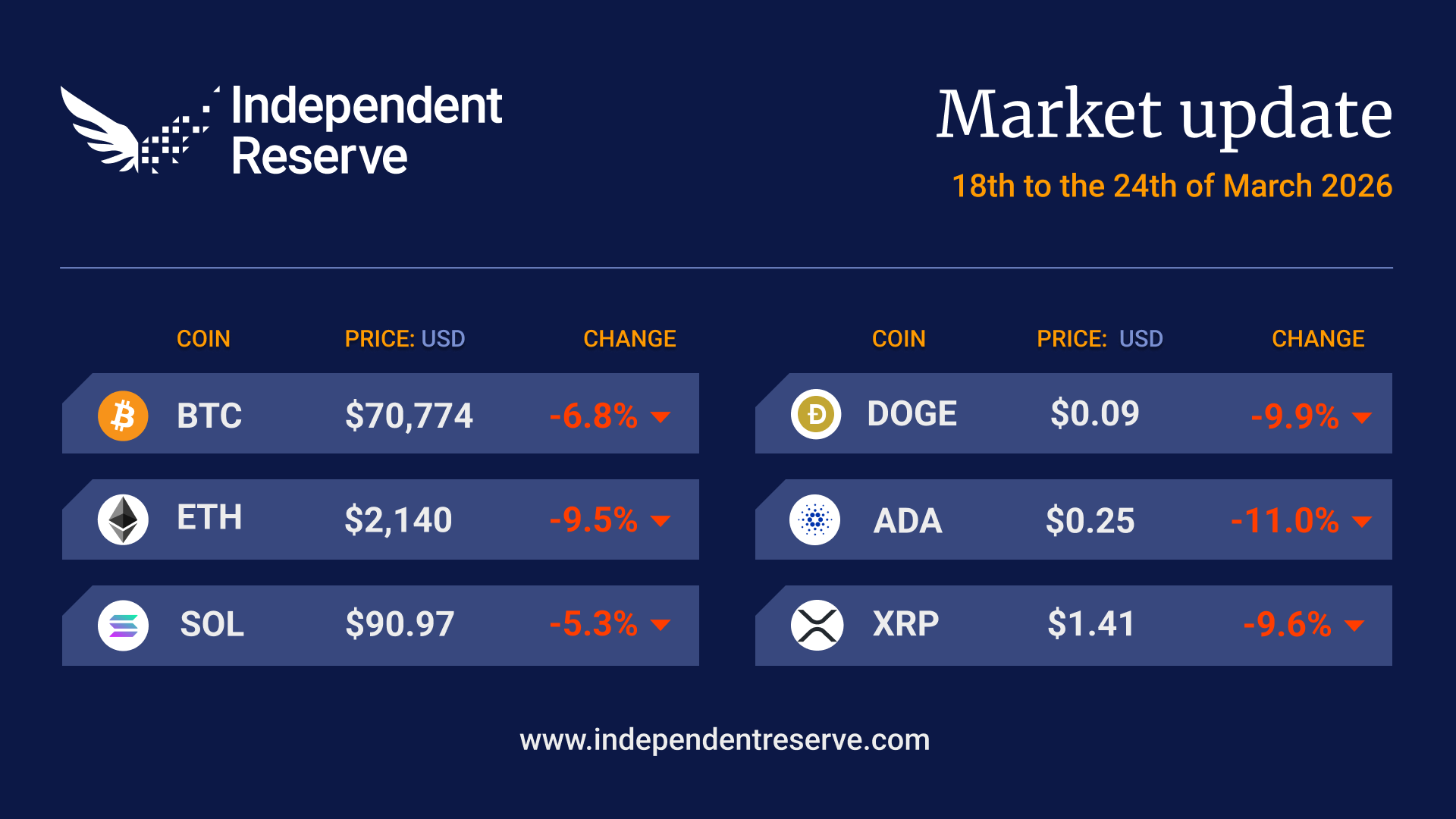
Bitcoin sold off sharply over the weekend after President Donald Trump delivered his 48-hour ultimatum that he would bomb Iranian power plants if they didn’t reopen the Strait of Hormuz. BTC subsequently gained 3.8% in 24 hours after Trump announced negotiations with Iran to end the war. He also extended the deadline for the Strait’s reopening to 5 days, giving ground troops time to arrive and delaying the next round of brinkmanship outside market hours. Brent Crude oil dropped 10 per cent on the news, and the S&P 500 ended up 1.1% for its best day since the war began. LunarCrush data suggests Bitcoin’s social media sentiment was already climbing before the news broke, and is now up 35% for the week. Bitcoin finishes the week down 6.8% on seven days ago and is trading around A$101,304 (US$70,774) while Ethereum is down 9.5% to trade around A$3,068 (US$2,140). XRP fell 9.6%, Solana lost 5.3%, Dogecoin (-9.9%) and Cardano (-11%). Bitcoin mining difficulty fell around 7.7%. The Crypto Fear and Greed Index is at 11, or Extreme Fear.
From the OTC desk
Hawkish stance continues to deter crypto investors
The hawkish stance from the Fed continues to deter investors from cryptocurrency markets. FOMC Chairman Jerome Powell cited war-driven inflation as a potential cause for concern. He added that the consequences of recent events remain uncertain, leading to a pause before the committee considers whether to cut rates. The oil rally, driven by supply disruptions in the Strait of Hormuz, could continue to fuel rising inflation and adversely affect risk assets. Before the FOMC meeting, ETF funds had a net inflow of US$635M, but this turned into an outflow of US$405M after the meeting, resulting in a net effect of +US$230M for the week.
Confusing week for safe-haven assets
Bitcoin has often been lauded as digital gold, but its correlation with physical gold has sharply collapsed amid idiosyncratic moves over the past week. Adding fuel to the fire were incendiary comments relating to the potential escalation of conflict following a 48-hour deadline issued by President Trump. However, markets reversed sharply yesterday as a new deadline was issued amid the President’s declaration of a positive outcome on social media.
Gold itself has taken a significant hit, dropping more than 30% from high to low over the course of the week. In fact, gold has been behaving like a risk asset, dipping sharply early in the week as tensions escalated, before recovering alongside the S&P 500 rebound. Oil prices appear to be behaving as the contrarian asset amid this conflict, moving inversely to the broader market.
OTC desk activity
- Market participants seemed keen to buy the dip over the week
- More on-ramp flows for the week
Key Economic Calendar Events (AEDT)
- Wednesday, Mar 25 2026 – 11:30 AM – AU Inflation Rate YoY Feb (Consensus 3.8%).
- Thursday, Mar 26 2026 – 04:00 PM – SG Industrial Production YoY Feb (Consensus 14.3%).
- Thursday, Mar 26 2026 – 11:30 PM – US Initial Jobless Claims Mar/21 (Consensus 210K).
- Monday, Mar 30 2026 – 08:00 PM – EA Economic Sentiment Mar (Consensus 96).
- Tuesday, Mar 31 2026 – 10:30 AM – JP Unemployment Rate Feb (Consensus 2.7%).
- Tuesday, Mar 31 2026 – 10:30 AM – JP Tokyo Core CPI YoY Mar (Consensus 2.0%).
- Tuesday, Mar 31 2026 – 08:00 PM – EA Inflation Rate YoY Flash Mar (Consensus 2.2%).
- Tuesday, Mar 31 2026 – 08:00 PM – EA Core Inflation Rate YoY Flash Mar (Consensus 2.3%).
In headlines
Finally getting some Clarity?
The odds of the US crypto market structure bill (the CLARITY Act) passing have hit 68% on Polymarket. The renewed optimism came after Republican Senator Thom Tillis and Democrat Senator Angela Alsobrooks said they have reached an “agreement in principle” on the thorny issue of stablecoin yield. Representatives from the crypto and banking industries will review the formal language this week. There aren’t many details yet, but the compromise will almost certainly prevent crypto firms from paying interest on stablecoin deposits. Senator Cynthia Lummis said last week that “anything that sounds like banking product terminology will not appear.” The deal needs to get done before the midterm elections, which the Democrats are expected to dominate. While many Democrats voted for the GENIUS Act, the likely heads of Banking and Finance Committees would be crypto critics Maxine Waters and Elizabeth Warren.
SEC and CFTC provide clear rules for crypto
The SEC has released its interpretation of how US federal securities laws apply to crypto assets and transactions, and it’s everything the industry could have hoped for. The SEC states most crypto assets are not securities, including Ethereum, Solana and XRP. It divides crypto assets into classes, including digital commodities, digital tools, digital collectibles such as NFTs, and stablecoins, none of which are securities. The only crypto assets the SEC believes are clearly securities are tokenised securities – things like stocks, bonds and funds in tokenised form. “While the interpretation provides long-needed clarity, I should like to assure this audience that it amounts to a beginning and not an end,” SEC chair Paul Atkins said this week.
Bitcoin’s quantum testnet
BTQ Technologies has launched Bitcoin Quantum Testnet v0.3.0 to test BIP 360, a proposed new quantum-resistant output type called Pay to Merkle Root. Current Taproot transactions can expose public keys, allowing a quantum attacker to, in theory, reverse-engineer the private key. More than 50 miners are participating in the testnet, along with an open-source community of more than 100 contributors.
Nasdaq to trade tokenised securities
The SEC has approved Nasdaq’s plans to trade tokenised stocks and ETFs on blockchain rails alongside traditional shares. Stocks eligible for tokenised trading would initially be limited to those in the Russell 1000 Index and major ETFs. Nasdaq has also partnered with crypto tech firm Talos to connect crypto traders to its Calypso platform, which TradFi uses to manage risk, margin, and collateral requirements.
Asian crypto news
South Korea’s main opposition, the People Power Party, has introduced a bill to abolish the planned 22% tax on crypto gains, due to take effect in 2027. The implementation was originally scheduled to go live in 2022, but has been delayed on three separate occasions. Japan’s Financial Services Agency plans to beef up penalties for crypto-related offences, increasing jail time from 3 years to 10 years and fines from 3 million yen to 10 million yen (A$27k-A$90k) for entities engaged in unregistered crypto sales. South Korea’s Financial Intelligence Unit has fined the Bithumb exchange US$24.6 million (A$35.1M) for anti-money laundering violations and suspended it from onboarding new users for 6 months. Japan-listed Bitcoin treasury Metaplanet has raised US$270 million (A$2385M) as part of its plans to amass 210,000 Bitcoin. Singapore-based ride-sharing app Ryde has adopted a crypto treasury strategy and will invest in Bitcoin, ETH and SOL.
Strategy more important than the halving?
In the past week, Strategy bought 23,368 Bitcoin, which is equivalent to taking seven weeks of the global Bitcoin mining output from the supply. The previous week it bought 17,994 Bitcoin, equating to around five or six weeks of newly mined Bitcoin. According to trader Grain of Salt, if Strategy keeps buying more Bitcoin than miners create, then halvings will “no longer matter.” Strategy has just announced a new US$42 billion (A$59.9B) raise to buy ever more Bitcoin. Meanwhile, Tom Lee’s BitMine has bought another 65,341 ETH, bringing its holdings to 3.86% of the total ETH supply.
Is Bitcoin a safe haven?
Gold’s safe-haven status is looking shakier, after it fell 11% last week for the largest weekly loss since 1983. The price then crashed by up to 10% in the past day before recovering after news of the Iran negotiations broke. In contrast, Bitcoin has gained about one-third against gold since the conflict began, leading Ash Crypto to claim it was the new “safe haven.” This, of course, should be tempered by the fact that the increase came after seven straight months of decline against gold. River has just released a chart claiming that Bitcoin has gained 12% since the war began and that it has seen similar or greater increases during other financial and geopolitical crises since 2020.
Scheduled Maintenance – Sunday 29th March
Please note that services will be unavailable on Sunday, the 29th of March 2026, between 2 PM and 7 PM AEDT for scheduled maintenance. Access to the portal and mobile app will be down for approximately five hours. For any extended delays, please check announcements on Twitter/X.
Independent Reserve Cryptocurrency Index (IRCI) 2026
Now in its seventh year, the Independent Reserve Cryptocurrency Index (IRCI) 2026 is an annual cross-sectional survey of over 2,000 Australians. The research captures the perspectives of everyday Australians and is balanced across gender, age and geographic distribution. The index is rated out of 100 and designed to reflect four key aspects of Australian attitudes towards cryptocurrency: awareness, adoption, trust and confidence.
The IRCI survey was conducted between 12 and 20 January 2026. The index moved from 54 in 2025 to 53 in 2026, reflecting a year of market volatility and shifting sentiment, even as institutional participation increased and regulatory oversight continued to evolve.
The Moonshot Dispatch
Join us every Tuesday at 3 pm (AEDT) as we cover the latest crypto news, price movements and all the Bitcoin banter you may have missed. Tune in weekly on Twitter/X, YouTube, & TikTok.
Until next week, happy trading!