In markets
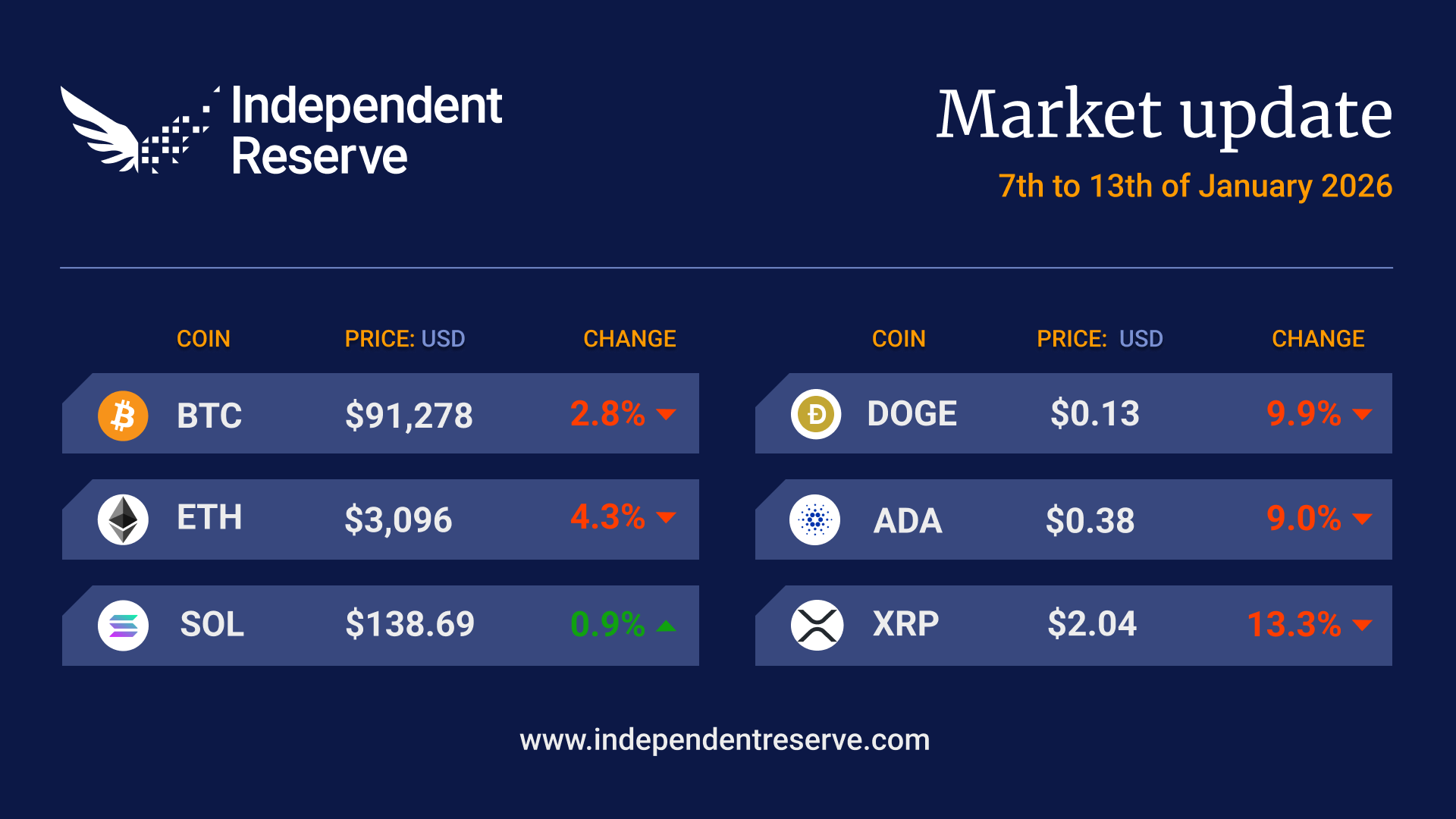
Crypto has held up reasonably well, considering the ongoing unrest in Iran, a politically tinged investigation into the US Fed chair, and regime change in Latin America. Adding some extra spice to the coming week, the US Supreme Court is set to rule on President Donald Trump’s tariffs on January 17, with considerable uncertainty surrounding the ruling and its potential market reaction. The fate of crypto market structure legislation in the immediate term will also likely be determined in a markup hearing this week. The risk-adjacent small caps Russell 2000 Index is at an all-time high, and the Iranian Rial has collapsed to approximately US$0.000001 (a decline of around 90% in value compared to last week). Bitcoin has continued to trade sideways and finishes the week down 2.8% to trade around US$91,278 while Ethereum is down 4.3% to US$3,096. XRP, which rose further previously, fell more this week and is down 11.9%, while Solana shrugged off another urgent client upgrade and the loss of 9.6% of its stablecoin supply in the past week to trade flat. Crypto YouTube viewership is at a year low, and the Crypto Fear and Greed Index is at 26, indicating Fear.
From the OTC desk
Escalating tensions between the U.S. administration and the Federal Reserve
The Justice Department served the US central bank with grand jury subpoenas over the past week, related to Chairman Jerome Powell’s prior congressional testimony on the Federal Reserve’s headquarters renovation project. Chairman Powell believes the action stems from differing views on interest rates and reflects broader administration pressure on monetary policy, making the situation increasingly resemble an open conflict between the White House and the central bank. President Donald Trump has denied any knowledge of or involvement in the subpoenas, stating they are unrelated to efforts to influence interest rates. These developments could directly affect global market liquidity, as they may influence the Fed’s dot plot and its interest rate projections for 2026 and beyond. Accordingly, lower interest rates reduce the effective risk-free rate and encourage risk-taking behaviour, which is likely to drive inflows into cryptocurrency markets. Bitcoin initially traded higher from US$90,000 to US$92,500, but has since been trading rangebound between those two levels.
OTC desk activity
The week saw light flows in spot trades, with more interest in selling on rallies.
Fierce stablecoin off-ramping was seen through the week.
Key economic calendar events (SGT)
- Tuesday, Jan 13 2026 – 07:30 AM – AU Westpac Consumer Confidence Change
- Tuesday, Jan 13 2026 – 09:30 PM – US Core Inflation Rate YoY (Consensus 2.7%)
- Wednesday, Jan 14 2026 – 11:00 AM – CN Balance of Trade (Consensus 113.6B)
- Wednesday, Jan 14 2026 – 09:30 PM – US PPI MoM (Consensus 0.3%)
- Wednesday, Jan 14 2026 – 09:30 PM – US Retail Sales MoM (Consensus 0.4%)
For any further information, please feel free to reach out.
In headlines
Critical week for CLARITY
The chair of the US Senate Banking Committee has announced “it’s time to move forward” with the CLARITY Act markup hearing on January 15. That’s a session in which lawmakers can discuss amendments to a draft of the Clarity Act before deciding whether to advance the bill to the overall Senate. The Agriculture Committee has just delayed its own hearing until the end of the month, which may be a good thing, as its chair previously said it would do so if progress were made on a bipartisan agreement to consolidate support. This, however, increases the risk that the entire bill will be delayed by a government shutdown. Republicans will need 7-10 Democratic votes for the bill to pass the Senate.
Areas of contention remain over whether the bill will ban stablecoin yields (as the banks want), how the rules will apply to DeFi, and if senior government officials will be blocked from profiting off crypto (squarely aimed at Trump). Crypto insiders say Democrats are negotiating in good faith and have been investing significant time and effort into the bills. Galaxy’s Alex Thorn says if four Democrats vote for it in the Banking Committee hearing this week, it’s likely the 17 Democrats who voted for the GENIUS stablecoin bill will also vote for it in the Senate. But it fails to get support in the committee, “the bill’s odds of passing in 2026 drop dramatically.” An advocacy group called “Investors for Transparency” is running TV ads on FOX News, urging viewers to oppose DeFi provisions with the tagline “Don’t let DeFi stall innovation.”
Korean companies can buy crypto
South Korea’s Financial Services Commission is reportedly about to lift a nine-year ban on listed companies owning crypto. New guidelines, due to be finalised over the next month or so, will permit 3,500 companies and professional investors to allocate up to 5% of their equity capital annually to the top 20 cryptocurrencies.
South Korea to flip Bitcoin ETF stance
Following the success of ETF products in the US and Hong Kong, the South Korean government plans to allow spot bitcoin ETFs this year as part of its 2026 growth strategy. The reversal of the rule coincides with strong domestic crypto adoption and a broader regulatory overhaul that includes a new Digital Asset Act to regulate stablecoins, which will be subject to licensing, full reserve backing, and redemption rights.
Separately, the government is also advancing plans to digitise public funds using government-issued tokens and expects lawmakers to vote on a long-awaited market structure bill next week.

Japan’s Finance Minister backs exchanges as gateway for digital assets
Japan is moving to integrate cryptocurrencies into its traditional securities framework, signalling that digital assets should be accessed through regulated exchanges. Finance Minister Satsuki Katayama also endorsed reforms to move crypto regulation under the Financial Instruments and Exchange Act and introduce a flat 20% tax on crypto profits aligned with equities.
Regulators have already implemented this approach by restricting unregistered platforms, prompting some exchanges to exit the Japanese market while simultaneously supporting regulated institutions, including banks, to take a larger role in crypto and stablecoin activities.
Dubai regulators prohibit privacy cryptocurrencies
Dubai’s financial regulator has banned privacy-focused cryptocurrencies such as Zcash and Monero, along with mixers and other obfuscation tools, across the Dubai International Financial Centre (DIFC), stating that their design makes compliance with international anti-money laundering standards impossible.
The updated framework also narrows the definition of stablecoins to only fiat-pegged tokens backed by high-quality, liquid assets, while classifying algorithmic products like Ethena as regular crypto tokens that remain permitted.
At the same time, the regulator has shifted responsibility for approving tokens to licensed firms, which must now assess and continuously review the suitability of the assets they offer.
Crypto ETFs
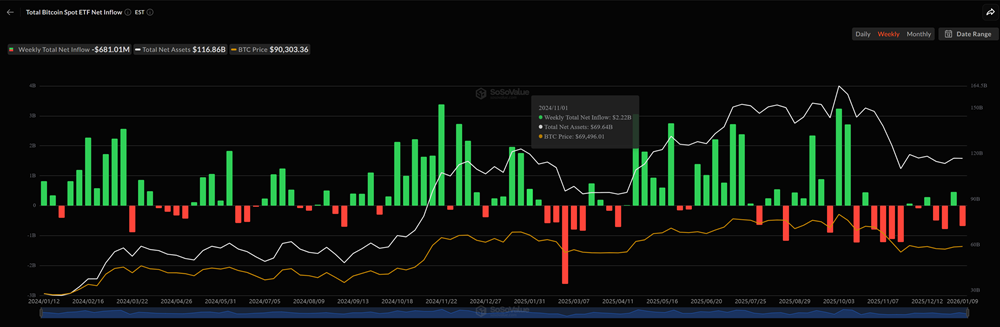
The year started well for the crypto ETFs, but went downhill last week with the Bitcoin ETFs shedding US$681 million and the Ether ETFs experiencing outflows of US$68.6 million despite the staking exit queue dropping to zero. Vincent Liu, chief investment officer at Kronos Research, said uncertainty was a significant factor weighing heavily on the market. “With Q1 rate cuts looking less likely and geopolitical risks rising, macro conditions have turned risk-off,” Liu said. “As traders wait for clearer positive signals, reduced risk appetite is spilling into crypto.” Morgan Stanley has filed for Solana, Bitcoin and Ether ETFs.
MSCI to keep Strategy in Index… but there’s a catch
The October 10 flash crash coincided with the news that Morgan Stanley Capital International (MSCI) was considering removing Strategy and other Digital Asset Treasuries (DATs) from its benchmark indexes. This move would have caused billions of dollars of forced selling. It has now been announced that DATs can stay in, but the indexes will ignore new equity created to raise money to buy more crypto. This will eliminate a significant amount of automated buying; however, if the share price rises, index funds will still need to purchase more to reflect the increased market capitalisation.
Bitcoin to $53 million
VanEck analysts Matthew Sigel and Patrick Bush have painted a glowing bull case for Bitcoin where it hits US$53 million by 2050 if it can overtake gold as a primary reserve asset. Their base case is US$2.9 million and bear case is just US$130K by 2050. The analysts suggest the bull case for Ethereum in 2030 is US$154K, the base case is US$22K, and the bear case is *cough* US$360. Standard Chartered, meanwhile, predicts that Ether will outperform Bitcoin, and the ETH/BTC ratio will return to its 2021 highs over time. It forecasts ETH will hit US$40K by the end of 2030.
Zcash hits turbulence
Zcash has increased by 740% over the past year, following a surge in interest in privacy coins, but is now embroiled in controversy. The entire team behind Zcash, known as the Electric Coin Company (ECC), has split from Bootstrap, the non-profit organisation created to support the token. CEO Josh Swihart said the Bootstrap board have “moved into clear misalignment with the mission of Zcash”, leading ECC to split. “This decision is simply about protecting our team’s work from malicious governance actions that have made it impossible to honour ECC’s original mission,” Swihart said.
X to roll out cashtags and trading
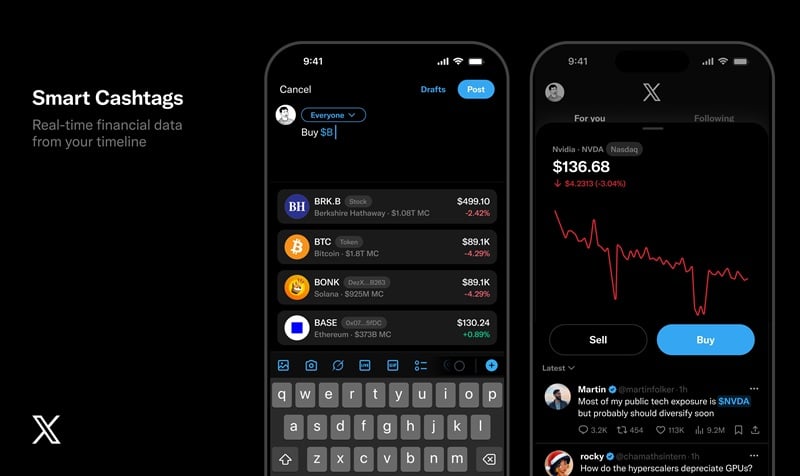
X (former Twitter) Head of Product Nikita Bier has previewed Smart Cashtags, which will enable users to post a crypto ticker that allows other users to click through for the price and other relevant information. He said the team is working over the next month to enable trading too. Bier said it was “probably the most well-received product preview we’ve done. It’s never been clearer: X shapes market sentiment and drives transactions in public & crypto markets, more than any other corner of the internet.”
Until next week, happy trading!