In markets
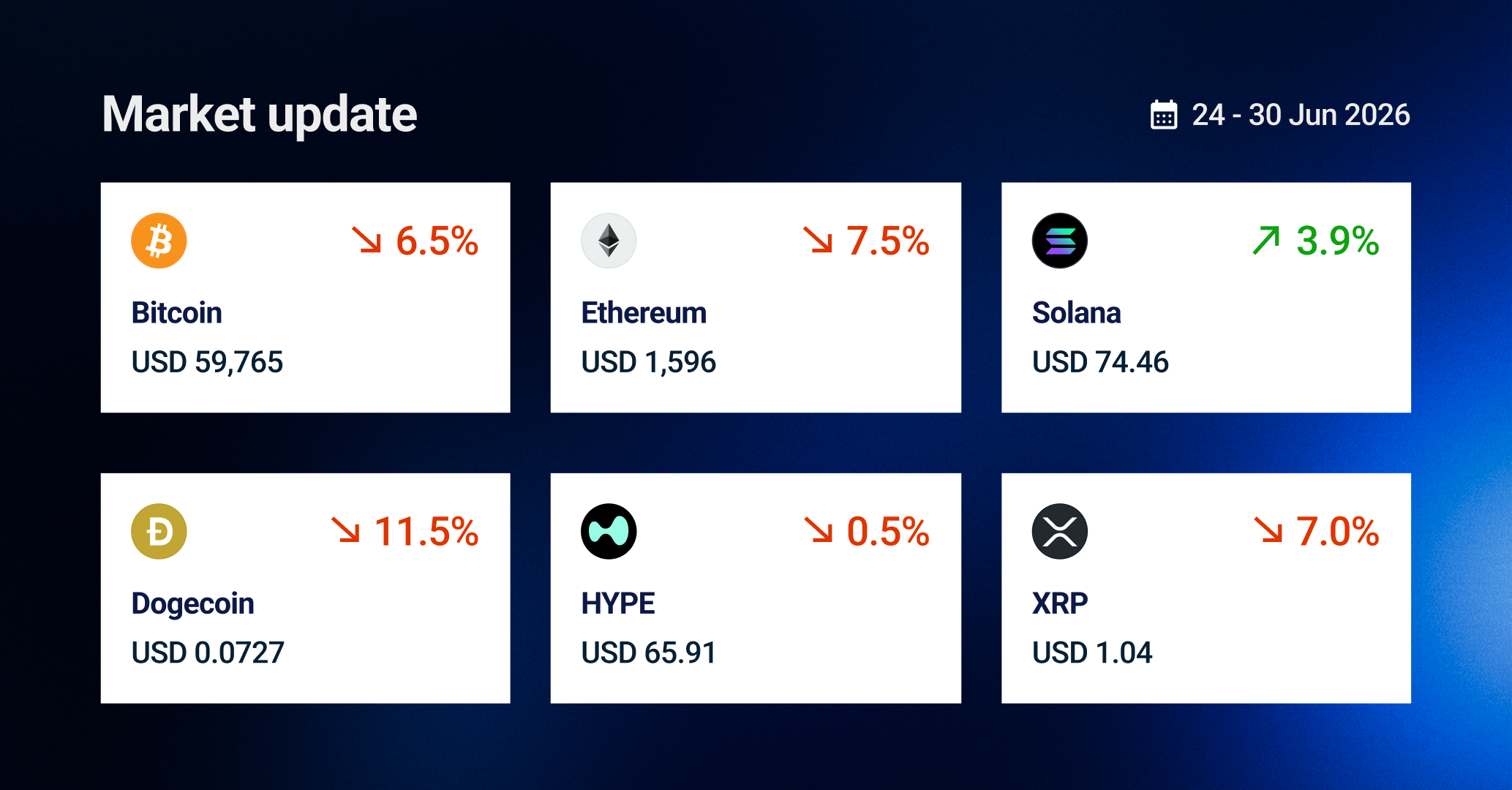
With the ceasefire between the US and Iran looking shaky and crypto market sentiment hitting rock bottom, Bitcoin fell below the psychological US$60K mark this week but found support around US$58K and trended back up. It finishes the week down 6.5%, trading around US$59,765. Ethereum lost another 7.5% to trade around US$1,596, and was briefly overtaken again in market cap by USDT.
Crypto has erased around US$8.8 billion of value every day since the October high, with the overall market cap falling by more than 54%. Bitcoin also lost 18.2% in June, making it the worst month of the year so far. History suggests that every negative June since 2013 has been followed by a bounce in July.
CryptoQuant data shows that more than 550,000 Bitcoin were deposited on Binance and OKX after falling below US$60K, suggesting some investors are prepping for a fire sale if prices slip further.
But while short-term traders and TradFi have been selling in bulk, on-chain indicators suggest long-term holders have been accumulating.
Altcoin investors remain at max pain levels, with analyst Michael van de Poppe pointing out that the altcoin market cap has erased all gains since 2023. “No wonder the markets are completely utter garbage in terms of sentiment,” he said
XRP lost 7% this week, Dogecoin fell 11.5%, but Solana gained 3.9%. The Crypto Fear and Greed Index is at 15, or Extreme Fear. A slew of US manufacturing and jobs data is set to be released this week, which could impact markets.
From the OTC desk
Is the worst over for BTC demand?
Bitcoin ETF outflows hit US$1.79B last week and US$4B for the month, with prices pinned near US$60K as institutional demand buckles under the Fed’s hawkish tone. The near-term picture looks uncomfortable, but the macro setup may be quietly shifting in BTC’s favour. Oil has collapsed roughly 20% through June, with Brent ending the month near $72 after a May peak of around $116. That disinflationary impulse could feed into the July CPI print on August 13, and a softer reading may be the trigger that pulls sidelined capital back into risk assets.
Watch the East: China’s liquidity valve could change the game
The PBOC’s debut of overnight reverse repo operations on June 29, injecting approximately $44.1B into money markets, is worth watching closely. One operation proves nothing, but if the PBOC repeats and scales this tool, traders may gain a live, daily read on Chinese liquidity conditions. It would not be the first time Chinese monetary easing moved crypto markets. In late 2024, a broad PBOC stimulus package that included rate cuts and reserve requirement reductions coincided with a sharp rally in risk assets, with Bitcoin climbing from around US$60K to above US$65K in the weeks that followed. With a potential inflation surprise and a newly active PBOC liquidity valve both on the horizon, conditions could be forming for a demand recovery into July, even if sentiment has yet to reflect it.
OTC desk activity
- Increased spot volumes as BTC skirts around US60K; the majority of flows are on the sell side
- Starting to see more sales come in from the stablecoin side, despite Tether trading at a significant discount
Key economic calendar events (AEST/SGT)
- 30 June 2026 – 10:00 PM / 08:00 PM – DE Inflation Rate YoY (Consensus 2.6%)
- 01 July 2026 – 09:50 AM / 07:50 AM – JP Large Manufacturers Index (Consensus 16)
- 01 July 2026 – 11:45 AM / 09:45 AM – CN Manufacturing PMI (Consensus 51.7)
- 01 July 2026 – 03:00 PM / 01:00 PM – JP Consumer Confidence (Consensus 34)
- 02 July 2026 – 07:00 AM / 05:00 PM – EA Inflation Rate YoY Flash (Consensus 3%)
- 02 July 2026 – 11:30 AM / 09:30 AM – AU Balance of Trade (Consensus A$2.3B)
- 02 July 2026 – 10:30 PM / 08:30 PM – US Non Farm Payrolls (Consensus 110K)
- 02 July 2026 – 10:30 PM / 08:30 PM – US Unemployment Rate (Consensus 4.3%)
In headlines
Rescue plan for STRC
Strategy’s MSTR stock and STRC preferred stock both gained more than 12% overnight, after Strategy released a new capital framework to address concerns swirling around the securities. It includes up to US$1 billion in MSTR buybacks and another US$1 billion in STRC (and related products) buybacks. The STRC dividend will increase to 12% tomorrow, and the company’s cash reserves have expanded to US$2.5B. Notably, Strategy announced it may sell up to US$1.25B of its Bitcoin holdings to manage dividends and debt if required. Benchmark-StoneX research analyst Mark Palmer called the framework a “direct, point-by-point answer to the concerns investors have been voicing.” While on social media, many are worried that Strategy could become this cycle’s FTX or Terra-Luna. Bitcoin market commentator Adam Livingstone modelled a scenario in which MSTR stock fell to US$1.01, was forced to sell 115K of Bitcoin, and Strategy still survived.
ETH Treasury companies join Russell
Bitmine has officially joined the Russell 1000 Index, which CoinDesk reports is “expected to drive institutional buying as ETFs tracking the index add $BMNR to their portfolios.” Its shares may be down 93% since July last year, but Bitmine is now 94% of the way toward its goal of securing 5% of the ETH supply. Meanwhile, SharpLink joined the Russell 2000 and finally bought another US$64.2 million worth of ETH last week, after an eight-month buying pause.

ASIC delays AFSL requirement
ASIC has given digital asset businesses that need an Australian Financial Services License a three-month deadline extension to September 30. The regulator said it has received about 30 license applications since it updated its guidance in October last year, clarifying that many digital asset products are financial products that require an AFSL. ASIC noted its recent court victory against BlockEarner underscored that point. Meanwhile, in the EU, Binance’s failure to secure MiCA approval has forced it to suspend services across the bloc.
CLARITY Act’s crucial two weeks
Galaxy says the odds of the Clarity Act passing have fallen to about 50/50, and the bill’s fate rests on two weeks of negotiations before the Senate returns on July 13. A defence bill has priority, however, meaning CLARITY won’t come near a vote until later in the month. It needs to get seven Democrats on board, with their support likely contingent on ethics provisions aimed at President Trump. A compromise allowing state attorneys to sue exchanges that list tokens promoted by public officials may help get that over the line. The Catholic Church weighed in this week, worried that the BRCA protections for devs could hamper investigations into human trafficking. Kristin Smith (Solana Policy Institute) believes there is a viable path to getting the bill done, as “politics are still in our favour.” The House Financial Services Committee has scheduled a hearing on the Clarity Act on July 17; this is not a vote.
South Korea pushes for tighter global crypto rules
South Korea is moving on multiple regulatory fronts simultaneously. Its Financial Intelligence Unit called on FATF to remove the minimum threshold from the Travel Rule, requiring all crypto transfers to carry sender and recipient data regardless of value, while a government delegation visited the US SEC to align frameworks on stablecoins and tokenised securities. At the same time, crypto exchanges have overtaken traditional banks for cross-border remittances among the Korean diaspora, with lenders like KBank and Toss Bank now investing in blockchain infrastructure to keep pace.

Indonesia introduces certification rules for influencers
Indonesia’s Financial Services Authority has introduced certification requirements for influencers who recommend crypto and other digital assets, stipulating that they may promote only assets listed on authorised exchanges and that any service provider they endorse must hold a licence. Indonesia joins Australia, the UK and the Philippines in tightening the rules around investment promotion on social media. The move reflects a regional shift toward holding retail-facing promotions to the same standards as licensed financial advice.
Trump can fire CFTC and SEC commissioners
The US Supreme Court has ruled the President can fire SEC and CFTC commissioners at will, overturning a 91-year-old precedent. This may complicate negotiations over the Clarity Act, as Democrats have pushed for bipartisan oversight of those agencies, but are not represented on either at the moment. The court said the President cannot fire Federal Reserve officials.
Hong Kong’s Cross-Boundary Wealth Connect Scheme set to expand
Hong Kong authorities are in discussions with mainland Chinese counterparts to broaden eligibility, increase quotas, and expand the range of products available under the Cross-boundary Wealth Management Connect scheme, which allows residents of Hong Kong, Macau, and nine Guangdong cities to invest in approved cross-border products. Discussions are also underway around greater access to Chinese and Hong Kong IPOs. The expansion comes amid Beijing’s crackdown on capital outflows, with analysts noting that Hong Kong’s regulatory autonomy and market depth give it an enduring edge over Shanghai.
Singapore is APAC’s leading wealth hub
A PwC report projects Asia-Pacific AUM will reach US$34.5 trillion by 2030, growing at 6.8% annually and outpacing both North America and Europe. Singapore, alongside Hong Kong, accounts for 8% of global sovereign wealth fund assets and is being positioned as a test bed for tokenised fund structures through MAS’s Project Guardian, an initiative exploring asset tokenisation to improve market liquidity. Separately, a Schroders survey found that 64% of Singaporean investors are now prioritising capital preservation, significantly above the regional average of 44%.
Japan’s institutional crypto moment arrives
Japan’s institutional embrace of digital assets accelerated sharply this week. SBI Holdings agreed to acquire cryptocurrency exchange Bitbank for US$289 million, the largest such deal in the country to date, while Circle announced plans to partner with Nomura on instant stablecoin-based foreign currency settlement for Japanese corporates as early as 2027.

Shallow bottom?
River put out a chart showing that Bitcoin’s drawdowns get progressively shallower with each cycle, from 93% in 2011 to 77% in the last cycle. To date, Bitcoin has lost 53% of its value. “Each Bitcoin bear market is shallower than the last, because the wave of high conviction buyers gets stronger every year,” River said. Jan3 CEO Samson Mow believes the bottom may already be behind us. “We had an ATH 37 days before the halving, so it would seem that even if you believe in cycles, you should reason out that the cycle’s accelerated. The bottom is in,” he said. However, KillaXBT suggests there may be a further 10%-15% before the bottom, but either way, “the downside from here is limited.”
The Moonshot Dispatch
Join us every Tuesday at 1 pm / 3 pm (SGT / AEST) as we cover the latest crypto news, price movements and all the Bitcoin banter you may have missed. Tune in weekly on Twitter/X, YouTube, Instagram & TikTok.
Until next week, happy trading!