Market insights
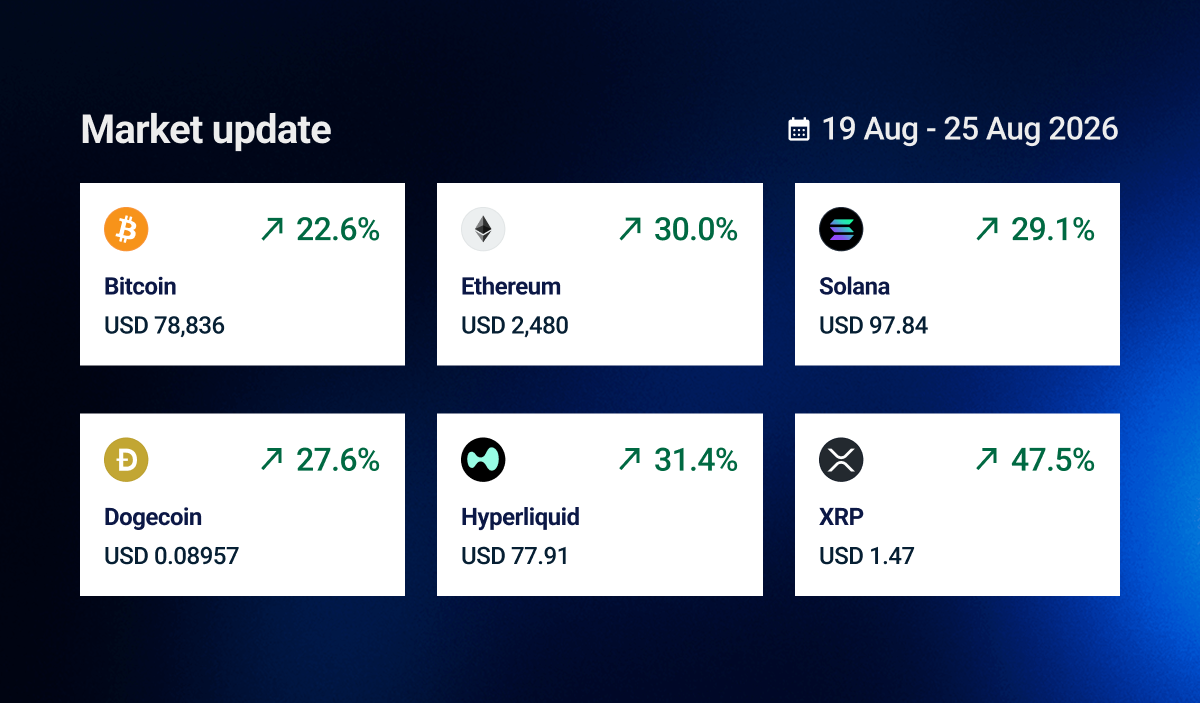
Bitcoin has held on to the gains it made in the recent monster rally, and August’s 26% return was the fourth-best August historically and the largest monthly gain since November 2024. Ethereum increased 34% over the past month, for the best result since July 2025. The ETH/BTC ratio gained 6% for the month, and analyst Ted Pillows noted the ETH price had made “higher highs” unlike Bitcoin so far.
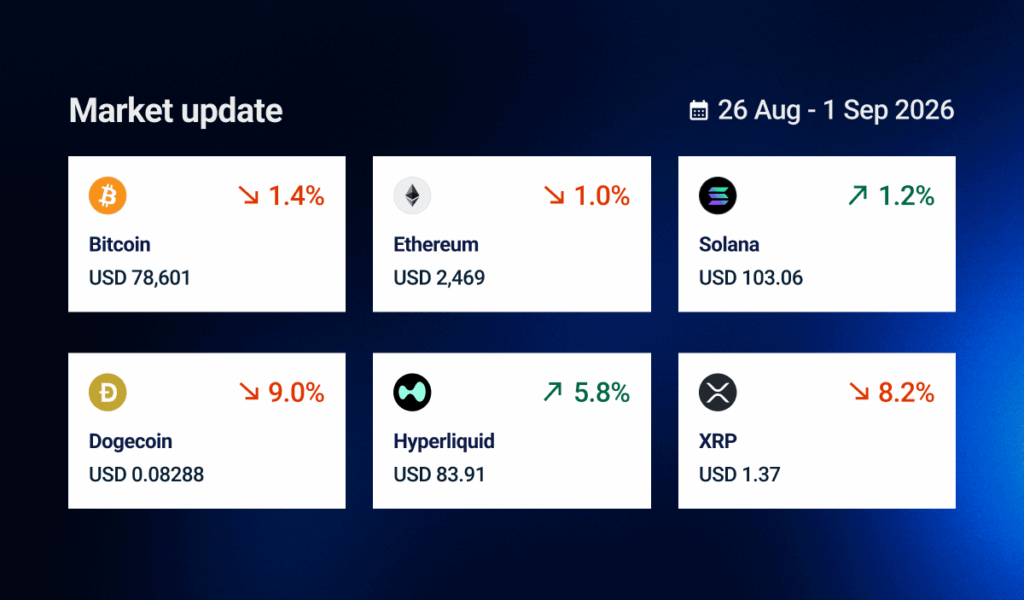
Bitcoin finishes the week flat at US$78,601, and Ethereum is also steady at US$ 2,469. XRP lost 8.2%, and Solana gained 1.2% after voting to curb inflation. Hyperliquid was up 5.8% on the news of a proposed partnership with Payward and Bitnomial to enter the US market.
Retail activity is beginning to heat up again, with Robinhood Chain taking US$1.01 million in 24-hour fees on Monday, more than Solana, Tron, or Ethereum, less than two months after it launched.
The Ethereum ETFs notched up ten straight days of inflows and took in US$824.42 million last week, while the Bitcoin ETFs saw US$924.5 million inflows.
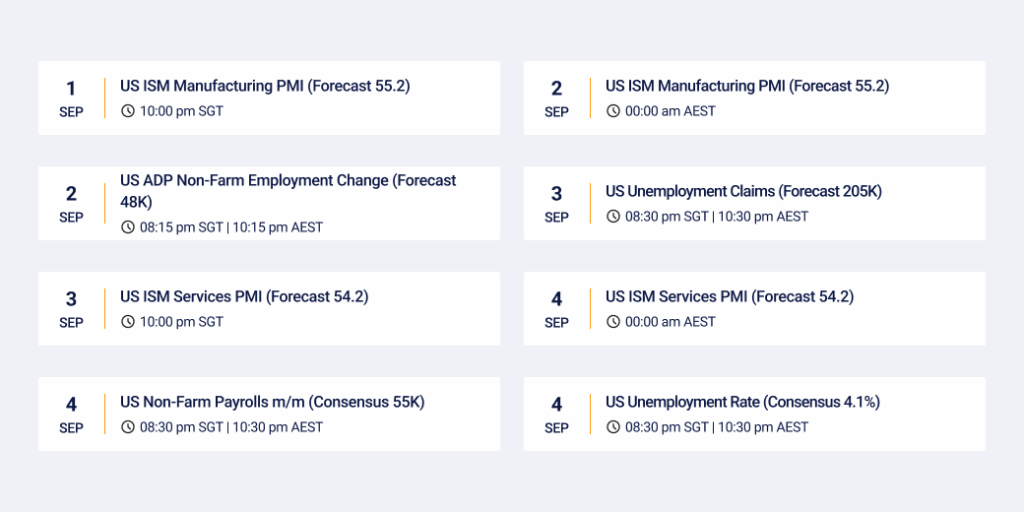
There are macro dangers ahead, however. Hawkish comments on inflation by US Federal Reserve Chair Kevin Warsh lifted the odds of a September rate hike to 62%. The US and Iran have also returned to exchanging missile fire, once again pushing Brent crude back over US$90 a barrel.
The Crypto Fear and Greed Index is at 62, or Greed.
Key economic calendar events
In headlines
Everybody’s talking about the “debasement trade”
The so-called “debasement trade” that’s been pumping crypto and precious metals has broken through into the mainstream. The Kobeissi Letter reports that the word “debasement” appeared in 1,533 Bloomberg articles last week, double the week before and the third-highest number of mentions on record. VanEck Asia Pacific Managing Director Arian Neiron told the Australian Financial Review the trade reflected a “fiscal reckoning” for the world’s largest economy. “The US is holding so much debt and long-term yields are at 2007 levels,” he said. “So the question for an investor is: well, if I’ve got too much US Treasuries, what is my real store of value? What’s the asset that’s really going to hedge the risk? That’s why the debasement trade has come to the fore again.” The US primary budget deficit of -3.58% is the largest among major advanced economies.
Bull-run incoming?
Conventional wisdom holds that a new Bitcoin bull market won’t be confirmed until the price holds above the 50-week moving average (WMA). Seen as the bear market ceiling, the target is currently around US$81.3K. Galaxy Research says the 50 WMA signal has held true for 11 of the past 13 bear markets. Wall Street research firm Bernstein believes the recent rally of 28% over ten days has already signalled the return of bull market conditions. It expects Bitcoin to reclaim US$125,000 by late 2026 in both its base and bull-case scenarios. Its base case would see Bitcoin at US$150K by mid-2027, peaking at US$300K in 2029, while its bull case suggests US$200K in less than a year and US$500K by 2029. Its long-term target for both scenarios is US$1 million by 2033.

Everybody loves stablecoins, except the Bank of International Settlements
Pablo Hernández de Cos, the chief of the Bank for International Settlements (BIS), argued this week that stablecoins do not credibly function as a means of payment at scale, and says that tokenised bank deposits should instead be used for most day-to-day payments. It’s increasingly a minority view, with a dozen large banks including Bank of America, Wells Fargo and Santander, advancing plans for a USD stablecoin project aimed at commercial clients across G7 currencies. The Wall Street Journal also reports that JPMorgan Chase held preliminary internal discussions about launching its own stablecoin, and Revolut has just launched a Euro-backed stablecoin called EURR for 2 million customers in Denmark, Poland and Portugal, with plans to expand. Revolut has more than 75 million app users across 40 different markets.
Singapore stablecoin trials
Singapore payments company Nium will test the use of USD and Euro-backed stablecoins for cross-border payment settlement outside of business hours using the Visa payments network. The trial is part of the Monetary Authority of Singapore’s Project Bloom and aims to reduce delays and give financial institutions faster access to funds. Bridge founder Zach Abrams told Fortune this week he believed Singapore businesses would embrace local stablecoins. “Businesses in Singapore are going to want to hold tokenised Singapore dollars, so they can convert them into Treasuries or other assets to earn yield,” he said. “The region is warming to stablecoins, but it’s not as warm as the U.S. yet,” Abrams said. In Hong Kong, Franklin Templeton and HashKey have launched a US tokenised money fund for professional investors, called the Franklin OnChain U.S. Government Liquidity Fund.
Quantum proofing Bitcoin and XRP
Blockstream researchers have published a new Bitcoin Improvement Proposal to upgrade Bitcoin with the SHRINCS signature scheme. While SHRINCS is 13.23 times smaller than the post-quantum signature scheme it was derived from, the smaller size has drawbacks, including requiring a huge 5,777-byte fallback transaction if you need to restore a wallet from the seed phrase. The BIP also warns that “a security proof is TODO.” StarkWare has just tested an experimental quantum secure transaction on the existing Bitcoin mainnet that protects against short-range attacks in the mempool. However, it takes hours of computation and costs around $200. Developers at Ripple have also laid out a four-stage plan to upgrade the XRP ledger to quantum secure, including an emergency fallback plan.
Solana disinflation
Solana validators have just voted to reduce the rate of inflation on the network, resulting in 18.9 million fewer SOL coming into existence over the next six years. Known as double disinflation, the plan will enable Solana to reach a 1.5% annual inflation rate within 2.8 years, instead of 5.7 years under the previous schedule.
Hegota hard fork
Ethereum’s core developers have confirmed EIP-8141 for next year’s Hegota hard fork. Known as Frame Transaction, the EIP combines native account abstraction (which turns accounts into smart wallets) with post-quantum readiness. It enables adding any signature scheme without a hard fork.
Until next week, happy trading.